
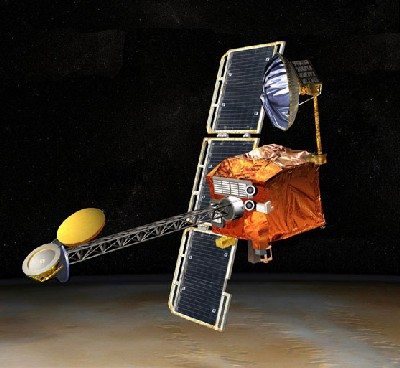
Named after 2001: A Space Odyssey, the movie that inspired a generation to believe in a future where travelers on their way to Jupiter could call loved ones from space hotels via live television links, NASA’s 2001 Odyssey orbiter mission has actually brought that fantasy one step closer to reality — via Mars.
With goals to detect health hazards for future human space explorers, to discover what our neighboring planet is made of, and to find buried water ice in the shallow subsurface of Mars, the 2001 Mars Odyssey orbiter has achieved mission success.
“As of August 24, 2004, the end date for its primary mission, Odyssey has officially fulfilled its science goals, and we look forward to refining our understanding of the red planet throughout an extended mission,” said Dr. Jeff Plaut, Odyssey project scientist.
PAVING THE WAY FOR ASTRONAUTS TO MARS
One goal of the Odyssey mission was to analyze the radiation environment to determine its potential effects on human health. Future adventurers who rocket out of the cradle of Earth towards Mars will leave Mother Earth’s protective atmosphere and magnetic field.
“In order to build the best spacecraft to get humans to Mars and the safest habitats for humans to live in once they’re there, we have to first know what exactly we’re up against,” explains Dr. Cary Zeitlin, principal investigator of the martian radiation environment experiment (MARIE).
Protecting Humans from Health Hazards
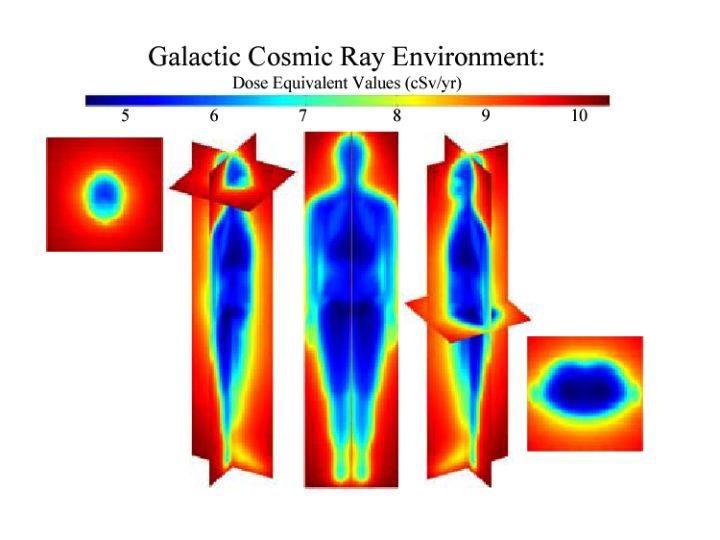
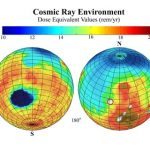
Mars has less than one percent of the atmosphere of Earth and no magnetic shielding from solar flares and galactic cosmic radiation from outside the solar system. Since space radiation can cause cancer and damage to the central nervous systems of crew members on interplanetary missions, MARIE was created to calculate the radiation exposure humans would experience on the way to, and in orbit around, Mars. MARIE measured radiation levels and found that Mars radiation is about 2 to 3 times higher than that around Earth.
Weather Satellites in Space
“For safe travel to Mars, we will need a coordinated system of satellites monitoring space weather at various locations throughout the solar system. The multiple satellites will help warn astronauts to go into ‘storm shelters’ that will protect them against intense, but relatively low-energy, solar flares.”
The International Space Station (ISS) has well-shielded areas too, but in the lower Earth orbit of the ISS, astronauts are still protected by the Earth’s magnetic field. In contrast, during the deep space journey to Mars, astronauts could fly over 100 million miles outside of the 30,000-mile (50,000-kilometer) radius of the Earth’s magnetic “shield.”
People living on Mars will likely need to limit the time they spend outside in their spacesuits as well as limit the distance they travel from their protective habitats. Astronauts on Mars will need to stay at a close enough distance to get to shelter when necessary.
“Satellites with radiation detectors like MARIE will detect solar particles blasting out of the Sun early enough that astronauts could have about a half-hour’s notice of an impending radiation storm,” says Zeitlin.
“If the solar activity models get better, it might also be possible to predict particle events many hours or maybe days ahead of time. That would be a big help,” Zeitlin adds.
If we send humans to Mars, Zeitlin believes that the potential benefit would be phenomenal. “There is so much people can do scientifically once they are on Mars, and the international cooperation that would flow out of putting that effort together would have big benefits on Earth,” said Zeitlin.
When asked if he would want to go to Mars as an astronaut, Zeitlin responded, “If I could come back to Earth.”
MARS STUDIES LEAD TO EARTH KNOWLEDGE
Home sweet home. “The more we learn about Mars, the more we learn about Earth,” explained Dr. Bill Boynton, principal investigator for the gamma ray spectrometer (GRS) suite of instruments that is mapping the elemental makeup of Mars. “Whether it was taking apart a clock or a lawnmower engine in grade school, I’ve always had to understand how things work. For me, Mars is the biggest challenge because it seems to be the most complicated planet in our solar system, other than Earth itself,” said Boynton.
What Earth and Mars are made of
Another goal of NASA’s Mars Program and the Odyssey mission is to characterize the geology of Mars. GRS has allowed scientists to make maps of the elemental composition of the martian surface for the elements hydrogen, silicon, iron, potassium, thorium, and chlorine. These and other chemical elements are the building blocks of minerals, minerals are the building blocks of rocks, and all of these relate to the structure and landforms of the martian surface. An understanding of what Mars is made of in turn provides clues to the geological and climatic history of Mars and the potential for finding past or present life.
Mission Success: The Magic of Mars Odyssey
Named after 2001: A Space Odyssey, the movie that inspired a generation to believe in a future where travelers on their way to Jupiter could call loved ones from space hotels via live television links, NASA’s 2001 Odyssey orbiter mission has actually brought that fantasy one step closer to reality — via Mars.
With goals to detect health hazards for future human space explorers, to discover what our neighboring planet is made of, and to find buried water ice in the shallow subsurface of Mars, the 2001 Mars Odyssey orbiter has achieved mission success.
“As of August 24, 2004, the end date for its primary mission, Odyssey has officially fulfilled its science goals, and we look forward to refining our understanding of the red planet throughout an extended mission,” said Dr. Jeff Plaut, Odyssey project scientist.
PAVING THE WAY FOR ASTRONAUTS TO MARS
One goal of the Odyssey mission was to analyze the radiation environment to determine its potential effects on human health. Future adventurers who rocket out of the cradle of Earth towards Mars will leave Mother Earth’s protective atmosphere and magnetic field.
“In order to build the best spacecraft to get humans to Mars and the safest habitats for humans to live in once they’re there, we have to first know what exactly we’re up against,” explains Dr. Cary Zeitlin, principal investigator of the martian radiation environment experiment (MARIE).
Protecting Humans from Health Hazards
Mars has less than one percent of the atmosphere of Earth and no magnetic shielding from solar flares and galactic cosmic radiation from outside the solar system. Since space radiation can cause cancer and damage to the central nervous systems of crew members on interplanetary missions, MARIE was created to calculate the radiation exposure humans would experience on the way to, and in orbit around, Mars. MARIE measured radiation levels and found that Mars radiation is about 2 to 3 times higher than that around Earth.
Weather Satellites in Space
“For safe travel to Mars, we will need a coordinated system of satellites monitoring space weather at various locations throughout the solar system. The multiple satellites will help warn astronauts to go into ‘storm shelters’ that will protect them against intense, but relatively low-energy, solar flares.”
The International Space Station (ISS) has well-shielded areas too, but in the lower Earth orbit of the ISS, astronauts are still protected by the Earth’s magnetic field. In contrast, during the deep space journey to Mars, astronauts could fly over 100 million miles outside of the 30,000-mile (50,000-kilometer) radius of the Earth’s magnetic “shield.”
People living on Mars will likely need to limit the time they spend outside in their spacesuits as well as limit the distance they travel from their protective habitats. Astronauts on Mars will need to stay at a close enough distance to get to shelter when necessary.
“Satellites with radiation detectors like MARIE will detect solar particles blasting out of the Sun early enough that astronauts could have about a half-hour’s notice of an impending radiation storm,” says Zeitlin.
“If the solar activity models get better, it might also be possible to predict particle events many hours or maybe days ahead of time. That would be a big help,” Zeitlin adds.
If we send humans to Mars, Zeitlin believes that the potential benefit would be phenomenal. “There is so much people can do scientifically once they are on Mars, and the international cooperation that would flow out of putting that effort together would have big benefits on Earth,” said Zeitlin.
When asked if he would want to go to Mars as an astronaut, Zeitlin responded, “If I could come back to Earth.”
MARS STUDIES LEAD TO EARTH KNOWLEDGE
Home sweet home. “The more we learn about Mars, the more we learn about Earth,” explained Dr. Bill Boynton, principal investigator for the gamma ray spectrometer (GRS) suite of instruments that is mapping the elemental makeup of Mars. “Whether it was taking apart a clock or a lawnmower engine in grade school, I’ve always had to understand how things work. For me, Mars is the biggest challenge because it seems to be the most complicated planet in our solar system, other than Earth itself,” said Boynton.
What Earth and Mars are made of
Another goal of NASA’s Mars Program and the Odyssey mission is to characterize the geology of Mars. GRS has allowed scientists to make maps of the elemental composition of the martian surface for the elements hydrogen, silicon, iron, potassium, thorium, and chlorine. These and other chemical elements are the building blocks of minerals, minerals are the building blocks of rocks, and all of these relate to the structure and landforms of the martian surface. An understanding of what Mars is made of in turn provides clues to the geological and climatic history of Mars and the potential for finding past or present life.
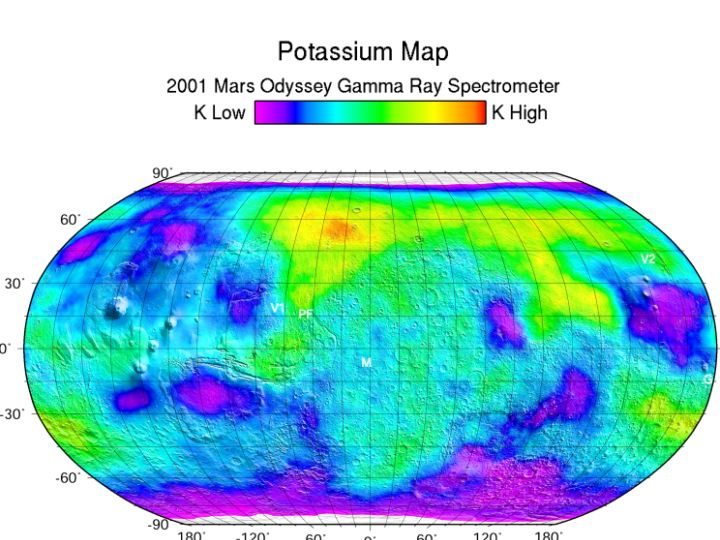
“We see one element, potassium, which is about twice as abundant as it is on Earth,” said Boynton. This fact was known in advance based on meteorite studies, but was confirmed by the GRS data. For the other elements, the team cannot yet tell if they are significantly different on Mars than on Earth. Hydrogen, for example, is mainly tied up in water, but scientists don’t know the total amount on either Mars or Earth because they don’t know how much is underground. “Even on Earth, there may be more water tied up in the Earth’s mantle (between the surface and the core) than in all the water in the oceans,” explained Boynton.
LIFE ON EARTH AND MARS
The elements Odyssey is finding on Mars are the same elements found on Earth. Some of these elements are essential to life as we know it. For example, iron is in our blood and helps carry oxygen to our lungs to breathe. Potassium is another trace element essential to life. Finding these elements on Mars means that microbial life could have been (or still be!) present on Mars because they are chemical building blocks for life and its processes.
The chemical information gained from Odyssey provides a base of knowledge that scientists can build upon to determine the likelihood of life on Mars.
Water is a key ingredient to life
On Earth, wherever there is liquid water, there is life. As far as biological research has shown, life seems to thrive in liquid, where molecules can run around and interact freely. Water, composed of hydrogen and oxygen, has a wide temperature range between freezing at 0 degrees Celsius (32 degrees Fahrenheit) and boiling at 100 degrees Celsius (212 degrees Fahrenheit), giving molecules a fair chance of combining and growing before locking up in frozen ice or boiling away as steam. What is unknown on Earth is how long it takes for life to form in liquid water. Odyssey and the Mars Program are attempting to find an answer.
How long does it take for life to develop in water?
“We don’t know how long it takes for life to form in the presence of water,” said Dr. Phil Christensen, principal investigator for the cameras on board Mars Odyssey. Earth is a dynamic planet, dominated by water, with a lot of current volcanic activity, weathering, and plate-tectonic action.
Both Earth and Mars are estimated at being about 4.5 billion years old. “The early history of Earth is so ground up due to current activity that you have to be very lucky to find rocks from the first half of Earth’s history. But on Mars, which hasn’t been weathered away, you may see rocks three or four billion years old right at the surface all over the planet,” explained Christensen.
“So, ultimately, Mars may provide the best opportunity to figure out how an environment for supporting life started on Earth.”
WATER ON MARS…IN THE PAST
The thermal emission imaging system (THEMIS) on Odyssey is both an infrared camera and a visible camera. It has captured telltale signs of past water on Mars. In four locations on Mars, THEMIS has detected high levels of hematite, a mineral that on Earth forms most often in the presence of liquid water. Discoveries by THEMIS and its predecessor instrument(TES (thermal emission spectrometer) on the Mars Global Surveyor orbiter) led the 2003 Mars Exploration Rover mission team to choose Meridiani Planum as a landing site for its hematite content.
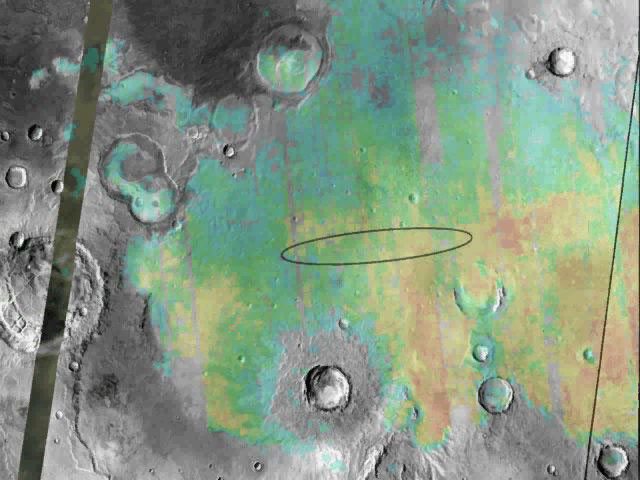
Since landing, data from the Opportunity rover’s science instruments, including the miniature thermal emission spectrometer (mini-TES) has since confirmed THEMIS’ results that the area was once covered in water.
“The morphology and thermal properties of the Meridiani Planum region indicate that the hematite-bearing area was deposited in a standing body of water that extended over 100,000 square kilometers (300 miles by 100 miles or about the size of Oklahoma), with smaller bodies of water in nearby crater basins,” said Christensen.
THEMIS, along with Christensen’s two other instruments at Mars (TES on Mars Global Surveyor and mini-TES on the rovers), has shown that liquid water could have been in a few areas within the equatorial region of Mars for thousands or tens of thousands of years.
ET ROVERS PHONE HOME THROUGH ODYSSEY
Beyond trying to solve the grand mysteries of life in the universe, Odyssey is chipping away at day-to-day tasks to help the rovers operate on Mars. Not only did the images from Odyssey and Mars Global Surveyor help plot the landing locations of the rovers, but Odyssey has also acted as a communications relay for the rovers, transmitting over 85 percent of the data from Spirit and Opportunity to Earth.
Pat Esposito, the lead navigator for the Mars Global Surveyor and Odyssey orbiters, explained that Odyssey’s polar orbit takes the spacecraft over Spirit and Opportunity at least twice a day, once on the “day” side and once on the “night” side per rover.
“Odyssey orbits Mars once every two hours, while Mars spins on its own axis. For every sequential orbit, Odyssey sees a different part of Mars underneath its cameras and instruments that is 28 degrees westward of its previous orbit ground-track,” explained Esposito.
Odyssey has a much bigger antenna than the rovers have, so Odyssey can transmit more data faster to Earth, and the orbiter has Earth in view longer from its perch above Mars. Odyssey isn’t quite sending streaming video from space like the movie 2001: A Space Odyssey predicted, but the orbiter is currently the exclusive data path for all the rover images. Almost nothing comes down to Earth that Odyssey doesn’t deliver.
SISTER SPACECRAFT IN A FAMILY OF MARS MISSIONS
Orbital images from Odyssey’s THEMIS cameras have helped steer the twin rovers to their daily dream locations for geologic research. THEMIS can reveal what is underneath a uniformly dust-covered terrain, using its infrared camera that detects heat. Since rocks retain their heat through the cold nights on Mars, THEMIS can “see” where rocky terrain is versus a sandy area beneath an otherwise common looking surface. “Geologists want to study rocks more than dust because rocks tell you the environment they formed in unlike fine dust grains do,” explained Christensen.
Odyssey is also already supporting the Phoenix Scout Mission with landing site selection images for Phoenix’s scheduled landing on Mars in late May of 2008 in the north polar region. GRS has also detected significant quantities of water ice buried in the polar regions of Mars, which is a key motivation for sending Phoenix to this area.
BURIED WATER ICE IN THE POLES
A final goal of the Odyssey mission was to search for subsurface water ice. “We have found that in the regions north and south of 60 degrees latitude, the surface is well over 50 percent water ice by volume.
If just the top meter of ice deposits around the martian north pole were melted, there would be enough liquid water to fill Lake Michigan,” explained Boynton.
“We are now thinking that during a past climate there was enough moisture in the atmosphere that we actually had snow fall on the surface that was mixed with a small amount of wind-blown dust,” said Boynton.
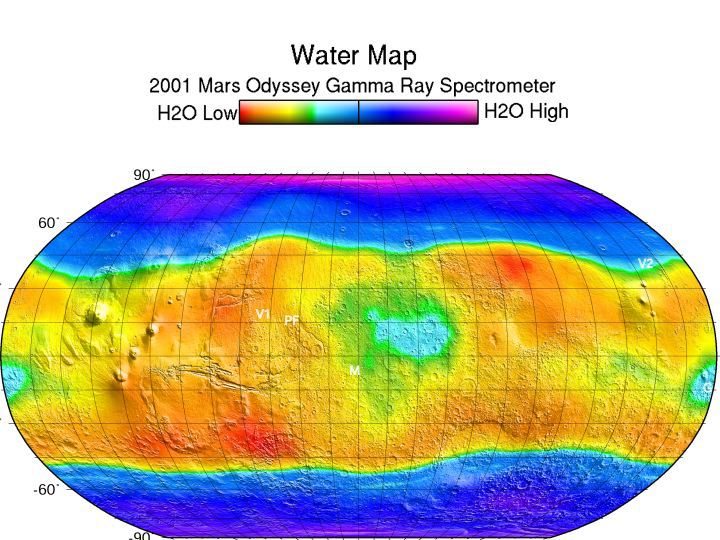
This discovery has significant implications for our understanding of the history of water and the possibilities for past and current life on Mars as well as the potential for supporting human exploration of the planet, since humans will need water to survive on Mars.
DEDICATED TEAM
The team behind the Odyssey mission is a dedicated group of individuals who have the passion to seek answers to difficult questions.
“I’ve just had a curiosity my whole life — why certain mountains are in one place versus another, or why dinosaurs went extinct,” said Christensen.
“As a scientist working on Mars, we get to ask similar questions about the formation of planets and the existence or non-existence of life at a place where no humans have ever been – we get to see a world that has been untouched for 4.5 billion years.”
END OF THE PRIMARY MISSION AND THE FUTURE OF ODYSSEY
August 24, 2004, marks the official end of Odyssey’s picture-perfect primary science mission. Odyssey’s new project manager, Phil Varghese, remembers watching the exciting evolution of the Odyssey mission as an “outsider” and admiring how launch, orbit insertion, and aerobraking all went perfectly. “Now, it’s even more exciting to be directly involved in the mission as we reach the full mission-success criteria,” said Varghese. “We have more than doubled the science return originally planned for Odyssey, from 125 gigabits to over 250 gigabits of data.”
The MARIE instrument on Odyssey was damaged last year, most likely by a solar particle entering the spacecraft and “frying” a computer chip. A similar incident happened during cruise, and after 6 months of remaining off, MARIE recovered itself. “We still have a glimmer of hope that it will turn back on 6 months from now since it recovered before by ‘black magic,’ which engineers officially call ‘annealing,'” said Zeitlin.
Arthur C. Clarke, the author of 2001: A Space Odyssey, once said that, “Any sufficiently advanced technology is indistinguishable from magic.” Built and operated by Lockheed Martin, the Odyssey spacecraft has definitely worked magic over the last 3 years.
“And Odyssey has enough flight system resources to carry on its science collection and relay capabilities through the next 10 years if things continue to go smoothly,” said Varghese.
“My nieces and nephews ask for all kinds of information about Mars, and I have high hopes that we will continue our work and Mars student programs for many years to come.”
More Instrument Information
For more detailed information about the instruments, please visit the instrument web sites.
The Gamma Ray Spectrometer, based at the University of Arizona, is a suite of instruments that includes a Neutron Spectrometer built by the Los Alamos National Laboratory and a High Energy Neutron Detector built by Russia’s Space Research Institute.
The Martian Radiation Environment Experiment was built by Johnson Space Center and the Principal Investigator is based at Lawrence Berkeley National Laboratory at the University of California, Berkeley.
The Thermal Emission Imaging System is operated by the team at Arizona State University.




Submit your review | |