
“All those motorists sitting at traffic lights cursing, should realize that
it is not Hydro-Quebec’s fault”
[Hydro-Quebec, 1989].
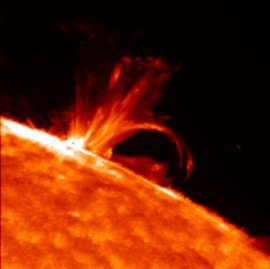
On Thursday, March 9, 1989 astronomers at the Kitt Peak Solar Observatory spotted a major solar flare in progress. Eight minutes later, the Earth’s outer atmosphere was struck by a wave of powerful ultraviolet and X-ray radiation. Then the next day, an even more powerful eruption launched a cloud of gas 36 times the size of the from Active Region 5395 nearly dead center on the Sun. The storm cloud rushed out from the Sun at a million miles an hour, and on the evening of Monday, March 13 it struck the Earth. Alaskan and Scandinavian observers were treated to a spectacular auroral display that night. Intense colors from the rare Great Aurora painted the skies around the world in vivid shapes that moved like legendary dragons. Ghostly celestial armies battled from sunset to midnight. Newspapers that reported this event considered the aurora, itself, to be the most newsworthy aspect of the storm. Seen as far south as Florida and Cuba, the vast majority of people in the Northern Hemisphere had never seen such a spectacle. Some even worried that a nuclear first-strike might be in progress.
Luke Pontin, a charter boat operator in the Florida Keys, described the colors in reddish hues as they reflected from the warm Caribbean waters. In Salt Lake City, Raymond Niesporek nearly lost his fish while starring transfixed at the northern display. He had no idea what it was until he returned home and heard about the rare aurora over Utah from the evening news. Although most of the Midwest was clouded over, in Austin Texas, Meteorologist Rich Knight at KXAN had to deal with hundreds of callers asking about what they were seeing. The first thing on many people’s mind was the Space Shuttle Discovery (STS-29) which had been launched on March 13 at 9:57:00 AM. Had it exploded? Was it coming apart and raining down over the Earth? Millions marveled at the beautiful celestial spectacle, and solar physicists delighted in the new data it brought to them, but many more were not so happy about it.
Silently, the storm had impacted the magnetic field of the Earth and caused a powerful jet stream of current to flow 1000 miles above the ground. Like a drunken serpent, its coils gyrated and swooped downwards in latitude, deep into North America. As midnight came and went, invisible electromagnetic forces were staging their own pitched battle in a vast arena bounded by the sky above and the rocky subterranean reaches of the Earth. A river of charged particles and electrons in the ionosphere flowed from west to east, inducing powerful electrical currents in the ground that surged into many natural nooks and crannies. There, beneath the surface, natural rock resistance murdered them quietly in the night. Nature has its own effective defenses for these currents, but human technology was not so fortunate on this particular night. The currents eventually found harbor in the electrical systems of Great Britain, the United States and Canada.
At 2:44:16 AM on March 13, all was well and power engineers at Hydro-Quebec resigned themselves to yet another night of watching loads come and go during the off-peak hours. The rest of the world had finished enjoying the dance of the aurora borealis, and were slumbering peacefully, preparing for another day’s work the next day. The engineers didn’t know, however, that for the last half-hour, their entire system had been under attack by powerful Earth currents. One second later, at 2:44:17 AM, these currents found a weak spot in the power grid of the Hydro-Quebec Power Authority. A 100-ton, static VAR capacitor Number 12 at the Chibougamau sub-station tripped and went off-line as harmonic currents induced by the electrojet flowing overhead, caused protective relays to sense overload conditions. The loss of voltage regulation at Chibougamau caused power swings and a reduction of power generation in the 735,000-volt La Grande transmission network. At 2:44:19 AM, a second capacitor followed suit at the same station. 150 kilometers away at the Albanel and Nemiskau stations, four more capacitors went off-line at 2:44:46. The last to fall at 2:45:16 AM was a static VAR capacitor at the Laverendrye complex to the south of Chibougamau. The fate of the network had been sealed in barely 59 seconds as the entire 9,460-megawatt output from Hydro-Quebec’s La Grande Hydroelectric Complex found itself without proper regulation.
In less than a minute, Quebec lost half of its electrical power generation. Automatic load-reduction systems tried to restore a balance between the loads connected to the power grid, and the massive loss of capacity now available. One by one, the load-reduction systems disconnected towns and regions across Quebec, but to no avail. Domestic heating and lighting systems began to flicker and go out. Eight seconds later at 2:45:24 AM, power swings tripped the supply lines from the 2,200 megawatt Churchill Falls generation complex. By 2:45:32 AM, the entire Quebec power grid collapsed, and most of the province found itself without power. The cascading of events was much too fast for human operators to react, but it was more than enough time for 21,500 megawatts of badly needed electrical power to suddenly disappear from service.
The nighttime temperature in Toronto was 19 degrees F (-6.8 C) with a high temperature that day of only 34 F (1.6 C) so the loss of electrical power was felt very dramatically as most people woke up to cold homes for breakfast. Over 3 million people live near Montreal, the second largest metropolitan area in Canada, where nearly half of the population of Quebec resides. It is famous for its 30 kilometers of underground walkways linking 60 buildings, two universities and thousands of shops and businesses. Over 500,000 people use this system each day to avoid the bracing cold winter air. Pedestrians using this electrically-lit system suddenly found themselves plunged into complete darkness, with only the feeble battery-powered safety lights to guide them to the surface.
The presses at the Montreal Gazette had been rolling at break-neck speed that night to print the Monday newspaper for its 195,000 subscribers, but the power failure shut the production down for a day. Huge rolls of paper weighing several tons each, came to a sudden halt, shredding paper in a storm of debris, and jamming the presses. The Montreal Gazette apologized to its customers in a news release on March 12, blaming what they had assumed was a local power failure in Montreal. Their sister newspaper, La Presse, seemed unaffected by the outage and helped The Gazette press their papers. The only casualty was the color, comics section which came out a day later. Dealing with their own emergency, they had little time to investigate just what had happened. A cursory call to Hydro-Quebec identified the cause of the outage as a defective 12,000-volt cable that provided The Gazette with power. There was no mention of any aurora sighted in Montreal, perhaps because of cloudy conditions and, of course, other more urgent matters. The 5000 subscribers who called the newspaper that day preferred to talk to the Customer Service operator complaining about not getting their morning newspaper. The tone of the reportage changed rather abruptly on March 14 when the details of the blackout had finally all emerged.
The blackout closed schools and businesses, kept the Montreal Metro shut down during the morning rush hour, and paralyzed Dorval Airport, delaying flights. Without their navigation radar online, no flight could land or takeoff until power had been restored. People ate their cold breakfasts in the dark and left for work. They soon found themselves stuck in congested traffic, which tried to navigate darkened intersections without any streetlights or traffic control systems operating. Like most modern cities, people work round the clock, and in the early morning hours of March 13, the Swing Shift staffed many office buildings in the caverns of Downtown Montreal. All these buildings were now pitch dark, stranding workers in dark offices, stairwells and elevators. It cost businesses tens of millions of dollars as it stalled production, idled workers and spoiled products.
Hydro-Quebec officials said that the vast power system was innocent. The fault, they said, was in the geography of Quebec, which had power lines extending much farther north than for other electrical systems. Many people soon pointed out that this was the second major blackout in less than a year, and that Hydro-Quebec’s outages totaled about nine hours per year, compared to neighboring Manitoba Power and Electric’s two hours per year average. Hydro-Quebec promised to invest another $2 billion to cut in half the number of yearly blackouts, but this didn’t derail the investigations that were called for by the government to see if Hydro-Quebec had been negligent. Energy Minister John Ciaccia echoed the sentiments of many people as they sat in snarled traffic facing blackened signals,
“It’s frustrating because despite all our efforts to upgrade the system, we still wake up at 5 AM with a total blackout.”
By 10:00 AM, power had been restored to most of the customers in Quebec, and by 11:00 AM all but 3,500 of the 842,000 customers were back in business. It would, however, be a complicated process to pick up the pieces. Isolated power failures were promised over the next 24 hours as Hydro-Quebec wrestled with re-starting their vast interconnection of power lines and transformers. Residential customers, they announced, would be at the bottom of the priority list for being re-connected. New York Power authorities lost 150 megawatts the moment Hydro-Quebec went down, and the New England Power Pool lost 1,410 megawatts at about the same time. Service to 96 utilities in six New England states was interrupted while other reserves of electrical power were bought and brought online. In a show of solidarity with their sister utility in the North, by 9:00 AM, New York Power and NEPool were sending over 1,100 megawatts of power up to Quebec to tide them over while the system was being brought back up again. Luckily, these states had the power to spare at the time. But just barely. Some of them had their own cliff hanger problems to deal with. Electrical power pools serving the Northeast United States had come very close to going down as well.
The electrojet currents, now flowing in the upper atmosphere, spread their impact far and wide, causing electrical disturbances throughout North America and Great Britain. A thousand miles away from Hydro-Quebec, Alleghney Power, which connected Maryland, Virginia, and Pennsylvania lost 10 of its 24 VAR capacitors as they were automatically taken off-line to avoid damage. A $12 million, 22,000-volt generator step-up transformer owned by the Public Service Electric and Gas Company of New Jersey experienced overheating and permanent insulation damage. This transformer was the linchpin in converting electricity from the Salem Nuclear Plant, and boosting it to 500,000 volts for transmission. Replacement power had to be bought for $400,000 to keep East Coast residents from sharing the same fate as their neighbors in Quebec. Luckily, the owners had a spare replacement transformer available, but it still took six months to install. Without the replacement, it would have taken a year to order a new one. Across the United States from coast to coast, over 200 transformer and relay problems erupted within minutes of the start of the March 13 storm. 50 million people in the United States went about their business, or slept, never suspecting that their electrical systems had been driven to the edge of disaster. Not since the Great Blackout of 1965 had U.S. citizens been involved in a similar outage. There would have been no place they could drive to in an hour to escape.
The solar flare and accompanying storm conditions did much more than cause a blackout and upset communications systems. Automatic garage doors in California suburbs began to open and close without apparent reason. Microchip production in the northeastern United States came to a halt several times because of the ionosphere’s magnetic activity. In space, geostationary communications satellites that sensed the Earth’s magnetic field in order to point themselves had to be manually repointed from the ground as the local field polarity reversed direction, nearly causing the satellite to flip upside down. Some satellites in polar orbits actually tumbled out of control for several hours. GOES weather satellite communications were interrupted causing weather images to be lost. NASA’s TDRS-1 communication satellite recorded over 250 anomalies caused by the increased particles flows into its sensitive electronics.
The Chicago Tribune and the Washington Post said nothing about the storm, or the blackout. Only a brief mention was made about it in European papers such as the London Times, and then only to comment on the spectacular aurora. The Fairbanks Daily News and the Anchorage Daily News ran several articles describing the auroral display, but also failed to mention the power outage, even though Quebec City and Montreal were blacked-out by the event. The Toronto Star in Quebec, at least on Page 3, considered the blackout in its own province to be a significant news event, and on March 13, 1989 announced, “Huge Storms on Sun linked to blackout that crippled Quebec”
“Fiery storms on the Sun may have caused yesterday’s huge power blackout that left almost 6 million people without heat or electricity for almost 9 hours…Premier Robert Bourassa did not believe the blackout will dissuade U.S. utilities from signing lucrative contracts to buy Quebec electricity, the cornerstone of the premier’s economic policies…An official from the New York Power Authority from which Hydro-Quebec bought 700 megawatts, said in an interview he would prefer that Quebec didn’t have so many power blackouts. ”
Meanwhile, the Space Shuttle Discovery was having its own mysterious problems. A sensor on one of the tanks supplying hydrogen to a fuel cell was showing unusually high pressure readings on March 13 “The hydrogen is exhibiting a pressure signature that we haven’t ever seen before” said the Flight Director Granville Pennington at the Johnson Space Center. Engineers tried, apparently unsuccessfully, to understand the odd readings in order to advise whether to end the flight a day early on Friday. No public connection was ever made between this instrument reading ‘glitch’ and the solar storm that crippled Quebec, but it is fair to say that the conjunction of these two events was not completely by chance.
In many ways, the Quebec blackout was a sanitized calamity. It was wrapped in a diversion of beautiful colors, and affected a distant population mostly while they slept. There were no houses torn asunder, or streets flooded in the manner of a hurricane or tornado. There was no dramatic footage of waves crashing against the beach. There were no cyclonic whirlwinds cutting a swath of destruction through Kansas trailer parks. The calamity passed without mention in the major metropolitan newspapers, yet six million people were affected as they woke to find no electricity to see them through a cold Quebec wintry night. Engineers from the major North American power companies were not so blasé about what some would later conclude, could easily have escalated into a $6 billion catastrophe affecting most U.S. East Coast cities. All that prevented 50 million more people in the U.S. from joining their Canadian friends in the dark were a dozen or so heroic capacitors on the Allegheny Power Network.
The Media seemed to have missed one of the most human impacts of the beautiful aurora they so meticulously described in article after article. Today the March 1989 ‘Quebec Blackout’ has reached legendary stature, at least among electrical engineers and space scientists, as an example of how solar storms can adversely affect us. It has even begun to appear in science textbooks. Fortunately, storms as powerful as this really are rather rare. It takes quite a solar wallop to cause anything like the conditions leading up to a Quebec-style blackout. When might we expect the next one to happen? About once every ten years or so, but the exact time is largely a game of chance.
Why should we care that we are now once again living under ‘sunspot maximum’ conditions? After all, we have already weathered at least five of these solar activity cycles since the end of World War II. What is different about the world today is that we are substantially more reliant upon computers and telecommunications to run our commerce, and even our forms of entertainment and recreation. In 1981, at the peak of solar cycle 21, there were 15 communication satellites in orbit. Cellular phones were rare and there were 800,000 PCs sold in the U.S. with 300 hosts on the Internet. By the time the peak of solar cycle 22 came around in 1989, there were 102 communication satellites, and 3 million cellular phone users in the United States. With the new Intel 80486-based PCs, you could send e-mail to your choice of 300,000 host machines on the Internet.
As we arrive at the peak of the 23rd sunspot cycle in 2000-2001, however, we enter a very different world far more reliant on what used to be the luxuries of the Space Age. By 2000, 349 communication satellites orbit the Earth supporting over $60 billion of commerce. Over 100 million people have cellular phones, and Global Positioning System handsets are a commonplace for people working, or camping, ‘off road’. By 2003, 400 million people will routinely use wireless data transmission via satellite channels. There will be over 10 million Internet hosts with 38% of US households Internet-connected. To support all of this, not only will we need more satellites, but we will need more electricity flowing in our power grid which will have to work under loads unheard of in the past. As voters continue to elect not to build more power plants, blackouts and brownouts will become more common as power companies run out of temporary sources of power to buy during peak-load conditions during the summer and winter.
As if to emphasize today’s exuberance and expectations, ‘Individual Investor’ magazine announced on its cover ‘The Sky’s the Limit: In the 21st century satellites will connect the globe’. The International telecommunications Union in Geneva has predicted that by 2005, the demand for voice and data transmission services will increase to $1.2 trillion. The fraction carried by satellite services will reach a staggering $80 billion.
To meet this demand, many commercial companies are launching; not just individual satellites, but entire networks of them with names like ‘Iridium’, ‘Teledesic’, ‘Skybridge’ and ‘SpaceWay’. The total cost of these systems alone represents a hardware investment of $35 billion between 1998 and 2004. The actual degree of vulnerability of these systems to solar storms is unknown, and will probably vary in a complex way depending on the kind of technology they use, and their deployment in space. They do, however, share some disturbing characteristics: They are all light-weight, sophisticated, built at the lowest cost, and following only a handful of design types replicated dozens and even hundreds of times, often with off-the-shelf electronics.
It is common to base future expectations on recent past experiences: “Past is prologue” some say. Increasingly, these past experiences with, for example, commercial space technology, do not extend back much beyond the last solar maximum in 1989-1990. So, when we wonder why infrequent events such as solar storms aren’t more noticeable, we have to remind ourselves that most of our experience comes from times when the Sun was simply not very active, and when we were a lot less technologically vulnerable.
Now more than ever, we depend on uninterrupted sources of power. Blackouts are amusing for about the first 60 seconds, then become intolerable. Along with our expensive personal computers, we routinely purchase ‘surge protectors’ to handle the many intermittent rises and falls of an increasingly complex power delivery system. No surge protectors can save us from Quebec-style blackouts. We have become dependent on our cell phones and pagers in a way that will tie critical moments in our private lives to the shotgun physics of satellite and power grid survival during invisible solar storms. When a single failed satellite like the Galaxy IV in May 1998 can catch 45 million pagers off guard, do we find ourselves more secure? Sometimes it can be dangerous and costly to gamble, although most of the time we seem to get by with hardly realizing that a calamity has passed over us. We actually seem to enjoy living on the technological ‘edge’. But when a corroded natural gas pipeline in the Urals sprung a leak and detonated in June 1989, 500 people died. Pipelines corrode, and solar storms hasten this process, with tragic consequences.
There is also a disturbing tendency of denial. In both the electrical power industry and in the satellite business, there seems to be a tendency not to recognize that certain ventures are inherently risky and intrinsically susceptible to solar and geophysical influences. At the same time that the emplacement of vital communications systems, and human activities in space, have escalated, our scientific understanding of how the Sun affects us has not kept up due to cutbacks in research funding.
Although no one can say for sure how current trends in thinking are going to play themselves out in the next 5-10 years, the evidence for how we have already been affected in the past is well documented. It all comes down to the simple fact that the Sun is not the most polite and well-behaved neighbor we would like to imagine it to be. Not only do we find ourselves between a rock and a hard place, but also we can not even tell when the next blow is likely to fall. There is no great mystery about what is going on. We have had a long history, spanning a century, of calamities spawned by solar disturbances.
In the chapters to follow, we are going to see why most experts feel we will be at greater risk for trouble during this, the 23rd Solar Cycle, than in many previous ones. What has changed during the last ten years is the level of our reliance upon sophisticated technology, and its widespread infiltration into every niche of modern society.

Submit your review | |