
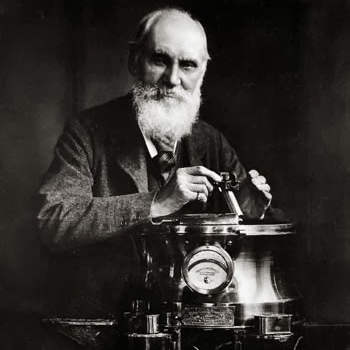
Timeline
1826 May 26 Richard Christopher Carrington born in Chelsea to Richard Carrington; proprietor of a Brewery in Brentford., Surry. In the MNRAS Obituary (MNRAS XXXVI p. 137) it is called the Bentford Brewery in 1876). His mother was Esther Clarke Aplin who married his father in Epsom, Surrey on May 24, 1823. The birth was recorded in St. Lukes Church in Chelsea.
Esther had three children baptized to Richard and Esther at St. Lukes Church in Chelsea:
Richard Christopher, baptized July 1825
David (born on 26 June and baptized on 23 July 1829)
Esther Fanny (born September 28, 1833 and baptized on October 30)
The following quote comes from Brentford Past by Gillian Clegg ISBN 0948667 79 6 published by Historical Publications Ltd in 2002. The Royal Brewery was taken over by Mr. Carrington the father of Richard Carrington the astronomer (1826 1876) It passed to Messrs Gibbon and Croxford, then to Montague Ballard (1880). It closed in 1923 when it was purchased by another brewery which in turn was later acquired by Courage. The Royal Brewery lay on the southern side of the High Street at the eastern end, not far from the bridnge over the Thames to Kew.
Brentford is an old town, formerly called Bregentforda in 781 AD and Brentforda in the Anglo Saxon Chronicles of 1016 AD. The settlement predates the Roman occupation of Britain and London itself. It has been suggested that Brentford was the main fording point across the Thames for Julius Caesar during his invasion of Britain. A battle in 54 AD between Caesar and the local king Cassivellaunus may have been fought here. Today it is the site of Kew Gardens and the Royal Botanic Gardens. And the Kew Observatory built in 1768 for King George III.
www.FamilySearch.org lists R.C. Carrington born on May 26 in Chelsea with a father Richard Carrington and a mother Esther Clarke. Recorded in St. Lukes Church in Chelsea.
1828 The Royal Brewery was established and renamed from its previous Red Lion Brewery when it was owned by Felix Booth. It was renamed at the suggestion of King William IV
1832 At age 7, Richard Carrington was sent to a school kept by Mr. Faithful at Hedley where he remained until his father sent him to be prepared for college in the house of a clergyman named Blogard.
1841 – There is a Will proved in the PCC for a Carrington living in Brentford. Elizabeth Carrington, widow of Brentford Butts April 21 1841 PROB 11/1944 also for Richard Carrington, Malt Distiller and Farmer of Thames Bank near Chelsea, Middlesex, December 19, 1835 PROB 11/1854 see www.documentsonline.nationalarchives.gov.uk)
1844 Entered Trinity College at age 18. Carringtons father had intended him for the Church, but in his preface to the Redhill Catalog Carrington explains that the tenour of my mathematical studies at the Universuity of Cambridge, acting on mechanical propensities to which I had always been addicted, gradualy mae it clear to me that I was more naturally adapted for the pursuit f some physical science involving observation and mechanical ingenuity; than for a profession like the Church.
1846 The PO Directory of London, Commerical Section lists:
Richard Carrington, malt distiller/corn distillers, Thames Bank, Pimlico
184x Took Prof James Challis (1803 1882) course/s on astronomy and was inspired. And he prepared himself for the work of an observatory. His father gave his consent without opposition. The obituary published in MNRAS XXXVI on Feb 11, 1876 states that as his probable future means promised him the opportunity of pursuing his selected occupation on his private resources, it was as he says with the object of acquiring experience and of avoiding wasteful and injudicious expense that he applied for and held for nearly three years the appointment of Observer at the University of Durham.
1848 Age 22 – Graduated Trinity as thirty-sixth wrangler.
1849 October, Age 23 – Began his observational work at University of Durham. Poor quality of facilities. Obituary notes that the observatory was so new that it didnt have much equipment. The result of Carringtons labors there were not very satisfactory to himself, and the accounts of his work can be found in a small book published in 1852. The University of Durham was founded in 1832. Women have been admitted to Durham since the 1890s. During the nineteenth and early twentieth centuries the numbers of students in Durham itself remained small. The University’s original endowment was insufficient to maintain the country’s first university course for engineers instituted in 1837 and, with the exception of Mathematics, science also declined The University Observatory was established in 1839, and built up a substantial library of over 600 titles, mostly series of published astronomical observations from other observatories and a complete run of the Nautical Almanac, but also including 17th-19th century monographs and numerous pamphlets and offprints. In 1953 the Observatory library and the bulk of the Observatory records, were deposited in the University Library.
The early books and periodicals have been incorporated in the University library’s Historical Science Collection. They include the first suppressed edition of John Flamsteed’s Historiae Coelestis Libri Duo (1712) from the Bignon collection, astronomical books from the collection of Thomas Wright (1711-86), the Durham polymath, via that of Thomas Thurlow, Bishop of Durham, among which are Wright’s annotated copies of his own Clavis Caelestis (1742) etc., and other early astronomical works from the collection of Dr. T.J. Hussey, the astronomer who supplied the Observatory’s first instruments.
Most post-1850 books and some periodicals have been incorporated in the general stock of the Library. A number of periodicals (runs of astronomical observations of other observatories) and the Observatory library’s pamphlet and offprint sequence have yet to be fully incorporated in the University Library’s stock, and are still kept together in a separate ‘Observatory Collection’ sequence.
1849
10/1-16. 1849 – 1853
Tables written on card:
Most of these tables appear to have been compiled by Richard Carrington, observer 1849 – 1852, based on his own or his predecesors’ observations. Some of them were later checked by William Ellis, observer 1852 – 1853.
10/1.
Table for reducing Barometer readings at different temperatures, to the same at 32° Fahrenheit.
Calculated by Professor Chevallier in 1844.
1 card
10/2.
Table of proportional parts, for Runs.
Proportional parts of a revolution of the screws of the the Transit Micrometer.
Both examined (by William Ellis).
1 card
10/3.
Intervals of the Transit wires.
Intervals for certain Polar Stars, calculated 20 March 1850.
Logarithms of the divided sums of the intervals of the Transit wires.
1 card
10/4.
Intervals of Transit wires as found in 1851, by Mr. Carrington.
Initialled W.E. (William Ellis), April 1852.
Intervals for Polaris. Initialled J.P. (John Plummer), November 1867.
Intervals of Transit wires found in 1867, illuminated end East.
Initialled J.P. (John Plummer), February 1868.
Intervals of Transit wires found in 1869-70, illuminated end East.
Initialled J.P. (John Plummer), January 1870.
1 card
10/5.
Table of the value of the Micrometer of the Transit circle.
Initialled W.E. (William Ellis), April 1852.
1 card
10/6.
Table for turning seconds of an arc into seconds of time.
The ratio RA (in time): 24 h. in decimals, for convenience in applying clock rates.
1 card
10/7.
Mean times of transit of Clock Stars in 1850.
Approximate North Polar distances of fundamental Stars.
1 card
10/8.
Table for converting the Right Ascension and North Polar Distance of the sun, moon, and planets, at Greenwich transit, to the same at Durham transit.
Table of proportional corrections, for change of declination, during the time of passage from the meridian to any wire, or intermediate interval.
1 card
10/9.
Table of factors for varying Right Ascension with formula for the sun or a planet and formula for the moon.
1 card
10/10.
Corrections of Polaris and of delta Ursa Minor, for curvature of path.
1 card
10/11.
A rough table of mean Refractions.
1 card
10/12.
Table for computing Refraction off the meridian at Durham.
Examined by W. Ellis, April 1852.
Refraction in Right Ascension and North Polar Distance.
Examined by W.E. (William Ellis), May 1852.
1 card
10/13.
Auxiliary table for the calculation of refraction off the meridian, with explanation initialled T.C. (Temple Chevallier), 5 May 1852.
1 card
10/14.
Table for computing Parallax off the meridian at Durham, with explanation.
Examined by W.E. (William Ellis), April 1852.
1 card
10/15.
A rough table of the moon’s parallax at Durham.
Airey’s correction to the moon’s equatorial horizontal parallax, to be used when the parallax is applied to the limit.
1 card
10/16.
Table for facilitating the reduction of clock comparisons.
temp. J. Plummer (observer 1867 – 1874)?
Paper 1f.
Durham Universityt Records
http://flambard.dur.ac.uk/dynaweb/handlist/sci/obsrvtry/@Generic__BookTextView/2530;td=3;pt=274
1851 March 14 admitted as a member of the Royal Astronomical Society.
1851 July 28 Age 25. Travels to Lilla Edet, Sweden to view the total solar eclipse. Publishes results in MNRAS XXI p. 58. Namnet Lilla Edet har sina rötter från 1500-talet. Det var på den tiden då här inte fanns några slussar, utan båtarna drogs på land över fallen. Ed betyder nämligen “väg förbi fall”, och förr hette Trollhättan därför Stora Edet! Lilla Edet ligger i Västra Götaland Lilla Edet kallades ursprungligen Bergaström vilket betyder “Strömmen mellan bergen”. Lilla Edet fick sitt nuvarande namn 1544.
Göta älv som kraftkälla har präglat verksamheten runt orten. Redan på 1400-talet anlades sågverk och kvarnar men sågverksrörelsen fick sin blomstringstid först på 1600-talet. Då kanalen och slussen anlades, kom tulluppbörden att förläggas till Lilla Edet.
I början av 1700-talet flyttade många människor in till samhället och invånarantalet uppgick till ca 600 personer. Under 1800-talet härjades samhället av flera bränder som ödelade både hus och industrier. Krig med danskar och norskar förstörde slussen ett flertal gånger.
I slutet av 1800-talet lades det sista sågverket ner och pappersindustrin började växa fram.
The eclipse path is shown in Fred Espenaks collection http://sunearth.gsfc.nasa.gov/eclipse/solar.html and in the saved image file.
1851 – 316. 15 February 1851
Letter from Robert Main of Greenwich Observatory to R.C. Carrington commenting on the results relating to clock errors.
Paper 2ff.
Found in V.38.
317.
Results concerning Clock Errors 18 January – 6 February 1851, supplied to Carrington by Greenwich Observatory.
Paper 1f.
Found in V.33. (Durham university records http://flambard.dur.ac.uk/dynaweb/handlist/sci/obsrvtry/@Generic__BookTextView/16805;td=3)
1852 April he concludes his observations at Durham Observatory and includes them in his Results of Astronomical Observations published in 1855.
1852 March, resigned his position at University of Durham. A small booklet of his research is published. The Obituary notes that he had little chance of obtaining more equipment at Dudley and this was a reason for his resignation. He had, however, taken advantage of the good opportunities for reading and had formed a plan for completing the survey of the heavens started by Bessel and Argelander. Which had only been carried by them to a declination of 81 degrees from the north celestial pole. He decided to re-do their survey to the 10th magnitude and extend it further in declination.
1852 Ownership of the Royal Brewery passes to Carrington and Whitehurst.
1852
Clock rates of Hardy: notes by R.C. Carrington.
Paper 1f. Durham Observatory Records http://flambard.dur.ac.uk/dynaweb/handlist/sci/obsrvtry/@Generic__BookTextView/2530;td=3;pt=274
1852 Age 26. In June he selected a site for an observatory and dwelling at Red Hill near Reigate, Surrey. In 1800, much of the land near Redhill was waterlogged wasteland. In 1818 a road was laid from Gatton Point through Red Hill and on to link with the London-Brighton Road at Povey Cross. But it was several more years before Redhill came into existence. A railroad line was built in 1842 to Dover, and a station created and named Reigate after the nearby town. In 1845, the name Red Hill existed only in Red Hill Common. Many railway workers settled nearby at a place that came to be called Little London. Following rapid population growth, St Johns Church was built in 1843. Little London was renamed St .Johns. In 1859 a public meeting began a movement to have Red Hill and Reigate become a Municipal Borough. In 1863 a Charter of Incorporation was granted by Queen Victoria.
Reigate is a town of great antiquity nestled among hills and trees. It once had a castle (http://www.castleuk.net/castle_lists_south/187/reigatecastle.htm) built by the Earls of Warren and Surrey, but it is now gone (smallreigateCastle.jpg). It once sat atop a hill overlooking the town. Today only public gardens mark the spot. (see http://www.oldredhill.com/)
In June 1852 Carrington identified the site upon which to build the observatory. Between summer and autumn of 1852 he built his observatory. (See preface to Spots on the Sun)
His transit instrument was a 5-inch refractor with a 5.5-foot focal length, and in ca 1876 it was at the Radcliffe Observatory in Oxford. This instrument is carefully described in Redhill Catalog. There was also a 4.5-inch refractor with a 4foot 4inch focal length, equatorially mounted for doing rough surveys of the polar region. The clock I now have was made by the late H. Appleton of 30 Southhampton Row, Russel Square. It has the dead-beat escapement; its rate is excellent, but the beat dull, and I have stil lsome difficulty in this respect to get over before I can set at defiance the sounds of a busy neighborhood (MNRAD letter XIV p.13).
His 1854 MNRAS article Notice respecting his observatory at Red Hill states that the telescopes were built by Mr Simms who fabricated both the optical and mechanical parts, and who has not been unmindful of his well-earned reputation The piers of the transit telescope were made from Caen stone and rested on a thick slab of York flag-stone, and laid on a considerable mass of concrete which he superintended. The north and south walls are of stone, 14-inches thick, and without windows. The party walls are 12-inch thick and of brick. The observatory is bounded on both sides by occupied rooms with fireplaces on opposite sides. Without windows, the observatory favors the generation of spiders.
Traughton and Simms were internationally renouned telescope and microscope makers. No home hobyists these! So the telescope much have been VERY expensive for the time.
The Obituary says that he superintended the progress of the building of the observatory. Because he did not have access to his instruments for research, he was led into the study of some series of drawings of the suns disk in the possession of the Society. Schwabe had recently discovered the sunspot cycle, and Sabine had found a complimentary periodicity in magnetic observations. Carrington was interested in this research but was disappointed with the quality of past sunspot observations. As a second interest Carrington noted that the observation of the stars required the hours of the night and afforded little matter for speculation. The observation of the sun was a day task and presented more variety and interest;.
1853 July Age 27. he completed the addition of a 5.5-foot transit circle and a 4.5-inch equatorial refractor, and began his work.
1853 November 9. He begins a careful and daily study of sunspots. This is the date of his first entry in his solar atlas which will be completed March 1861. He eventually discovered the differential rotation of the sun, and was able to create a detailed law for describing this motion as a function of solar latitude, a feat not accomplished by previous observers such as Peters (1845).
1853 December 9 submitted to the Astronomical Society maps of all stars to 9th magnitude within 9degrees of pole. (MNRAS XIV p. 40)
1854 Carrington publishes a detailed account of his Red Hill observatory (MNRAS XIV p. 13) and we learn that its latitude = 51d 14 25.25 North and longitude = 0d 0m 41.25 West. In the same issue (p. 153 ) he also publishes his On a Method of Observing the Positions of Spots on the Sun with an Example of its Application.
1855 Richard Proctor enters Kings College London. He was a delicate child, and, his father dying in 1850, his mother attended herself to his education. On his health improving he was sent
to Kings College, London, from which he obtained a scholarship at St Johns College,
1855
325. 10 December 1855
Letter from R.C. Carrington at Redhill Observatory, Reigate, to Professor Chevallier concerning his work on the Polar Stars.
Paper 2ff.
Durham University Archives (http://flambard.dur.ac.uk/dynaweb/handlist/sci/obsrvtry/@Generic__BookTextView/16805;td=3)
1855 Publication of his Durham work Results of Astronomical Observations made at the Observatory of the University of Durham from October 1849 to April 1852 (Durham, 1855).
1856 Richard Proctor transfers to Cambridge.
1856 Age 30. Completed atlas of 3735 circumpolar stars.
1856 Visits Germany and Heinrich Schwabe at Dessau to discuss solar studies.
1857 He was commissioned by the Royal Society to transmit the medal of our Society to Schwabe the aged astronomer of Dessau for his long labors which had resulted in the discovery of the sun spot cycle.
1857 February Age 31. Elected Honorary Secretary of Royal Astronomical Society. (Obituary)
1857 Catalog of Stars published, describing his instruments at Redhill . Often called the Redhill Catalog.
1858 July. Age 32. Sudden death of his father. Richard takes up responsibility for the Brentford Brewery (according to the Obituary)
1858 Publishes in MNRAS the article On the Evidence which the observed Motions of the Solar Spots offer for the existence of an Atmosphere surrounding the sun (MNRAS ) followed by On the Distribution of the Solar Spots in Latitude between the years 1854 and 1858 (MNRAS ) and On certain Phenomena in the Motions of Solar Spots (MNRAS
1859 Brentford becomes a railway stop on the Great Western and Brentford Railways branch.
1859 Feb 11, received gold medal of Royal Astronomical Society for his circumpolar atlas. (MNRAS XIX, p. 162)
The Gold Medal is the highest award of the Royal Astronomical Society. In the early years, more than one medal was often awarded in a year, but by 1833 only one medal was being awarded per year. This caused a problem when Neptune was discovered in 1846, because many felt an award should jointly be made to John Couch Adams and Urbain Le Verrier. A controversy arose and no award was made in 1847. The controversy was “resolved” by giving 12 “testimonial” awards in 1848 to various people including Adams and Le Verrier, and in 1849 awards resumed, with a limit of one per year. Adams and Le Verrier did not get their gold medals until 1866 and 1868, respectively.
http://www.wordiq.com/definition/Gold_Medal_of_the_Royal_Astronomical_Society
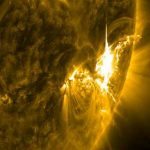
1859, September 1 Age 33. views the solar flare with his friend Hodgson at Highgate. They independently submit nearly identical sightings. (See bio file on Hodgson) (MNRAS XX, p. 13). It isnt clear of they really were friends, or if te comment simply meant that Hodgson was a friend of the Royal Society. At the time of the observation, they lived many miles apart.
1860 At age 23 – Richard Proctor graduates from Cambridge with a bachelors degree. He graduated as 23rd wrangler. His marriage while still an undergraduate probably accounted for his low place in the tripos. His wife was Mary Proctor.
1860 June 7 Age 34. Elected Fellow of Royal Astronomical Society.
1860 Eves Survey of Reigate Borough is completed and list owners of buildings etc.
1861 Prof Challis steps down as Director of Cambridge Observatory, but Carrington fails to win nomination for this post. Some sources say that this disappointment caused a decline in his health and spirits so he gave up astronomy.(*1) At the age of 42, John Couch Adams assumes Directorship in 1861. He was one of the two people (LeVerrire) who independently predicted the location of Neptune in 1846. Adams was clearly the superior candidate based on his research and educational achievements. Adams became Regius Professor of Mathematics at St Andrews in 1858. In 1859 he succeeded Peacock as Lowndean Professor of Astronomy and Geometry at Cambridge and held the post for over 32 years.
1861 March. His duties with the brewery force him to give up solar research. His assistant, Dr. Schroeder ends his stay at Redhill and the solar observations come to an end. Also, Carrington notes in his preface to Spots on the Sun, I decided to close the series and wind up the results I had obtained; the necessity of my being personally engaged in commerce still continuing; and the prospect of my being able to give an observers attention to the subject having become very remote, in consequence of a decision respecting a certain appointment to which I shall not more particularly allude. This clearly refers to his shattered expectation that he would be the next Director, and so enjoy unlimited opportunities to observe.
1862 Age 36. Steps down as Secretary of Royal Astronomical Society, during which time the writer of his MNRAS obituary calls him indefatiguable
1862 Mary Proctor born two years after Richard gets his bachelors degree in Cambridge.
1863 December. The first Mayor of Reigate/Redhill is elected
Reigate Quaker and local lime and coal merchant (he ran the first coal wharf at Redhill Station), Dann was one of the prime movers of a campaign to change the old Manor of Reigate, with its rapidly growing new town of Redhill, into a unified scheme of local government suited to the times. His outspoken ways aroused hard feelings against him, as did his social standing in a class-conscious era. Information originally obtained suggested that Thomas Dann died in May 1872 aged 72 but this would seem to be incorrect as information kindly supplied by Mr Sean Hawkins reveals that a coal and lime merchant aged 77 by the same name is shown on the 1881 census as living with his wife, Charlotte (aged 59) in London Road, Reigate. Comprehensive cover of Dann’s 4 year fight for incorporation, plus his term in office, is dealt with in ‘A History of Redhill’ vol. 1. (http://www.redhill-history.fsnet.co.uk/mayors.htm)
1863 Observations of Spots on the Sun Made at Redhill is published.
1865 Age 39. Severe illness leaves his health permanently impaired. His active work for the Society ends.
Carrington sells the brewery to ., and moves to a lonely spot at Churt, Surrey (Obituary). Sets up new observatory on Middle Devils Jump. His property at an elevation of 60-feet above the countryside occupies 19 acres of land 6 miles south of Fareham on part of Frensham Common in the village of Churt. Latitude 51d 8 49 North, Longitude 0h 3m 1.7s West. Farnham is the nearest post town and railway station. (MNRAS XXX p. 43).
1865 Proctor at age 28 read for the bar, but turned to astronomy and authorship instead, and in 1865 published an article on the Colours of Double Stars in the Cornhill Magazine. The Cornhill Magazine (1860 1975) was founded by George Smith in 1860. The first editor was William Makepeace Thackeray and the journal specialized in the serialization of novels.
1865 Proctors first book Saturn and its System is self-published. This work contains an elaborate account of the phenomena presented by the planet; but although favourably received by astronomers, it had no great sale. At the time of writing the book,
Proctor was the key shareholder in a New Zealand bank but unfortunately the bank failed, consuming all his capital and leaving him to ponder his future.
1866 Richard Proctor elected Fellow of the Royal Astronomical Society.
1869 Marries Rosa Jeffries in the July-September Quarter in the Pancras (Middlesex) Registration District (according to FreeBMN.com, and a letter I got on October 19, 2004 from Celia)
1870 Proctor publishes Other Worlds than Ours. On page 20 of the Fourth Edition, Proctor describes the Carrington and Hodgson observation of the flare The light of this spot was so intense that he imagined the screen which shaded the plate employed to receive the solar image had been broken. By a fortunate coincidence another observer, Mr. Hodgson, happened to be watching the sun at the same instant and witnessed the same remarkable appearance. (more about the flare and its magnetic and telegraphic impact follows.
1871 – A possible first child from their union may have been Susannah Harriet Carrington between Oct-Dec 1871 registered at Pancras Registration District. Other children? Annie Frances Carrington Apr-June 1874 and Katherine Maynard A. Carrington Apr-June 1875. (according to Celias letter to me and her geneology search)
1872 Proctor begins as Editor of Proceedings of Royal Astronomical Society and eventually contributed eighty-three separate papers to its Monthly Notices
1873 At age 36, Richard Proctor elected honorary Fellow of Kings College and ends Editorship position with RAS..
1873, January 10 Age 47. Carringtons last communique to the Astronomical Society about his double azimuth instrument.
1874 A survey map was drawn up of Redhill area identifies Carringtons location as The Observatory. Carringtons comment in 1852 about the noisy neighborhood is supported by the location of the Observatory so close to the town center and railroad spurs. St Johns Church had been built in 1843, so this was a growing community.
1874 – December 9 Transit of Venus. Did Carrington observe it before he dies a year later? What was the weather report for that day?
In MNRAS XXX p. 43 he describes his new observatory at Churt, but on page 46 Richard Proctor discusses the Mercury Transit of 1868 and the importance of viewing the 1874 and 1882 transits of Venus upcoming! If Carrington had read his own published article, he most certainly would have seen Proctors article too.
1875 November 17. Age 49. Mrs. Carrington found dead in her bed, possibly from overdose of chloral. He was investigated for improper nursing. He leaves the house on day of inquest. (celias geneology search says that there were two deaths registered in Farnham Richard age 50 and Rose Helen Carrington age 30)
1875 November 27 Age 49. He is seen to return to his house, but is never seen alive again.
1875 Age 49. A poultice of tea leaves was found over his left ear as if for relief of pain. Post mortem investigation shows that death came from an effusion of blood on the brain. A verdict of sudden death from natural causes was recorded. His Obituary cites he died from a rupture of a blood vessel on the brain.
Ca 1876 Carringtons manuscript books purchased by Lord Lindsay (Now Earl of Crawford) and presented to the Royal Society (MNRAS XXXVI p. 249). Carrington had also bequeathed 2000 pounds to the Society.
What happened to Carringtons instruments?
4.5-inch equatorial refractor spotted flare with this Built by Mr. Simms.
5.5-foot transit circle made star catalog with this
At Radcliff Observatory in Oxford ca 1876 (MNRAS XXXVI p. 139) Built by Mr. Simms.
See Item 40404 at the Museum of History and Science-Oxford which lists Transit Instrument, incomplete, by Troughton & Simms, London Distance between trunions 360 mm; telescope length 620 mm.
Double-Azimuth Instrument nothing productive resulted
1880 Royal Brewery bought by Montague Ballard who was the Maidstone hop grower, and incorporated as a limited company
in 1890.
1900 Only the Royal Brewery survives from a once booming bear and ale business in Brentford.
1922 The Royal Brewery (Brentford) Ltd. On 23 High Street was bought, along with its 102 pubs. The beer for the pubs was now supplied by Style and Winch.
1923 June 2 The Royal Brewery closes for good.
1926 Royal Brewery demolished and the property incorporated into the Brentford Gas Works.
1988 The last gasholder was demolished from the Gas Works.
1999 Barrat West London buys the 4.3-acre site from British Gas and builds a high-rise apartment complex. (www.barrathomes.co.uk)
Additional Notes:
* Chloral, a compound of chlorine with oxygen, hydrogen, and carbon. The chloral of the druggist and physician is a compound of choral and water, and is termed hydrate of choral by the chemist. In this form it is a white, crystalline substance having an acrid taste and a pungent odor. In medicine, a dose of from five to twenty grains is sometimes given to produce sleep. It is thought that choral, introduced into the system, is acted upon by the alkali of the blood in such a manner as to liberate chloroform, which acts directly on the nerves of the brain. An overdose of chloral overdoes the quieting process and paralyzes the brain, the heart, and the lungs, and brings on death. Chloral is a standard remedy for insomnia, but it should on no account be taken, except under the advice of a competent physician.
First synthesized in 1832, chloral hydrate was the first depressant developed for the specific purpose of inducing sleep. Currently marketed as syrups or soft gelatin capsules, chloral hydrate takes effect in a relatively short time (about 30 minutes) and will induce sleep in an hour. In Victorian England, a solution of chloral and alcohol constituted the infamous “knockout drops” or “Mickey Finn.”
Effusion of blood on the brain was not a trivial matter
1916 William Graham, 21, a pitman at Murton Colliery, died from injuries he received in a fight on the evening of Wednesday, 5 April with fellow pitman, William Gilroy. Gilroy was waiting with others at the pit mouth for Graham to come to bank. When he got out of the cage, Gilroy said to him, “Are you ready to fight as you said you were this morning?”, and then hit him. They then repaired to an adjoining field and fought about three-quarters of an hour; during the last round the deceased was knocked down by Gilroy and the latter fell on his breast with his knees, after this the deceased was unable to fight any longer, and he was carried home. A surgeon was sent for, but he was unable to save Graham whose body was a mass of bruises and contusions. The surgeon stated that Graham had died from “an effusion of blood from the brain”, between it and the pleura matter. At the inquest, the jury asked the Coroner to issue a warrant for Gilroy’s arrest on a charge of manslaughter. http://www.dmm.org.uk/names/a1848-01.htm
1881 – Thursday on the body of Griffith PARRY, aged 68, a sailmaker, who lived with a nephew, Hugh JONES, a labourer of 7 Court, Harding St. The deceased left JONESS house on the 28th ult and returned the following morning. He was addicted to drink and was found covered in blood. He said he had fallen into a clay pit and missed his way. He died Tuesday last, Dr E. HOUGHTON conducted a post mortem and said the cause of death was, effusion of blood on the brain, due to excessive drinking.
http://freepages.genealogy.rootsweb.com/~dadds/deathsinquests4A.html
1) in 1861 Carrington failed in his bid to secure the directorship of Cambridge Observatory, in succession to his former astronomy teacher James Challis. Challis had been Director since 1836.
Bitterly disappointed, Carrington shortly thereafter put an end to his astronomical work at Redhill. Both his health and his marriage degraded from that point on, culminating in November 1875 with the death of his wife from a drug overdose. Ten days later, Carrington himself died, officially of a brain hemorrhage.
http://www.hao.ucar.edu/public/education/sp/images/carrington.html
Porter, R. (ed.) 1994, The Biographical Dictionary of Scientists, Oxford University Press.
Forbes, E.G., The Dictionary of Scientific Biographies, 1980-1990, new York
Meadows, A.J. 1970, Early Solar Physics, Pergamon.
Eve’s 1860 survey (a detailed mapping of the Borough of Reigate showing fields, houses, common land etc. as numbered plots accompanied by an index that listed ownership of each)
Reigate area:
Predominantly open countryside, the Borough has an area of 50 square miles and is traversed by the North Downs escarpment, which is a designated Area of Outstanding Natural Beauty, and the Greensand ridge.
Together these divide the chalk uplands of Banstead from the Weald to the south. The Borough therefore enjoys a varied and attractive landscape, and many a natural beauty spot.
Amidst the countryside are the bustling towns of Banstead, Reigate, Redhill and Horley accommodating a total population of just over 127,000. The towns and villages within the Borough are a mix of ancient and modern including an historic market town, railway towns and dormitory villages. Magnificent scenery and breathtaking views are available to walkers, cyclists and picnickers across the Borough, and there is plenty of choice, with 3,000 acres of public open space and 1,300 acres of woodland to explore.
Local people love their parks, with our parks and open spaces achieving the second highest satisfaction rating in the country in a national poll.
The largest park, Priory Park in Reigate offers 200 acres of space and woodland and was once home to Lord Howard Effingham, Admiral of the Fleet at the time of the Spanish Armada.
In addition to being a place of great beauty, the park also has sporting areas and facilities for children, and during the summer plays host to a number of open air concerts and festivals.
http://www.surreybusiness.com/boroughs/reigate_banstead/reigate_banstead.asp
Red Hill
Redhill
Though it is thought of by some as a new town there has actually been a settlement in Redhill since the early 19th century.
The building of a road linking Gatton Point to Salfords led to the development of a hamlet known as Warwick Town, and when the London to Brighton railway was built in the 1830s the first seeds of a major town on the site were well and truly sown.
By 1841 trains were running on a daily basis and the town began to boom, providing housing and facilities for railway workers and users alike. Within nine years a branch line was built taking passengers from Redhill to Reigate and off across Surrey.
At the time it was known as Reigate Junction but by the end of the 1850s it had been renamed: ‘Red Hill Junction’.
The look of the town itself has changed much over the years and would be unrecognisable to someone who knew it at the beginning of the 20th century.
Many of the buildings which were erected in the nineteenth century have been replaced by more modern counterparts such as the Warwick Quadrant and the Belfry Shopping Centre.
http://www.surreybusiness.com/boroughs/reigate_banstead/reigate_banstead.asp
Surry:
The chief streams besides the Thames are the Wey, the Mole, and the Wandle. Mineral springs are at Epsom, Chobham, Streatham, Kingston, Dulwich, Godstone, Stoke, and Dorking. Lower chalk rocks, chiefly Weald clay, occupy all the S; upper chalk rocks form a belt along the course of the central line of downs; and lower and middle eocene rocks, with large preponderance of London clay, occupy all the rest of the area. Ragstone, manorial chalk, fire clay, and fullers’ earth are the chief useful minerals.
The soils correspond much to the character of the underlying rocks, yet exhibit considerable intermixture of chalk, clay, loam, and humus, and are exceedingly various. More than 60,000 acres are heath. The county is one of the driest and warmest in England. Agricultural practice varies with the character of the land and with distance from the metropolis. Wheat yields from 2 to 6 quarters per acre, barley from 4 to 7 quarters. Beans, pease, and turnips are much grown on the arable lands; clover, sainfoin, and woad on certain soils; hops are cultivated near Farnham; cabbages, carrots, parsnips, asparagus, and kindred plants are currently cultivated in the market-gardens; and enormous quantities of mint, lavender, camomile, liquorice, rosemary, hyssop, and other seasoning or medical plants are raised in Mitcham and its neighbourhood. Farms average from 200 to 300 acres, but are of all sizes. Cattle of various breeds are fattened; house-Iamb, particularly around Guildford, is reared for the markets; sheep, chiefly Southdowns, are pastured in the centre and in the west; and Berkshire pigs and Dorking fowls are largely kept.
http://www.uk-genealogy.org.uk/gazetteer/england/Surrey/
From west to east the sandy heaths, beech clad hills and rolling chalkland of the North Downs provide open space and very pleasant walking. Indeed, the most important routes in Surrey are the North Downs Way from Farnham to the Kent border and, on the southern parallel Greensand Ridge, the Greensand Way, from Haselmere to Limpsfield. The Vanguard Way also travels across Surrey during it’s journey from London to the south coast.
There are a number of beauty spots in Surrey which can become quite busy near car parks or visitor centres, but which provide good starting points for walks. Box Hill (NT) on the North Downs is an outstanding area of woodland and chalk downland providing some beautiful walking with spectacular views towards the south downs. Further south at Leith Hill (NT) on the Greensand Ridge, the highest point in south east England, there are more secluded walks amongst woodland containing ancient stands of hazel and oak. There are magnifient views from the summit and the area is famous for its colourful display of rhododendrons between May and June, a good time to plan a walk here. Another good location is Hindhead Commons and the stunning scenery of the Devil’s Punchbowl.
http://www.walkingpages.co.uk/places/CP_surrey_intro.htm
Walks in the Surrey Hills by: Janet Spayne and Audrey Krynski. This book of walks, now in its eight edition, has once more been completely revised and updated by Janet Spayne and Audrey Krynski. A local best-seller since the day of publication, the book describes twenty walks along and over the North Downs of Surrey from Guildford past Dorking, Redhill and Reigate to Chelsham. Each walk is accompanied by a sketch map, information on how to reach the start, where to park and the degree of difficulty (if any). There are alternative routes for those with children, and suggested places for refreshment along the way. The twenty walks offer a safe and exhilarating morning or afternoon in some of the widest variety of countryside to be found in England.
Churches and cemetaries:
Chelsea (1846 born)
St. Lukes Church
RedHill (1852 1861)
St. Johns Church (built 1843) still there
Christian Fellowship (Redhill)
Holy Trinity, Redhill
Carlton Road
Redhill
Surrey
RH1 2BX
Redhill Baptist Church
Redhill Christian Fellowship
Redhill URC
Redhill Vineyard
Reigate and Redhill Community Church
St Joseph Catholic Church
St Teresa of the Child Jesus
Station Road Church
The Salvation Army
Tollgate Evangelical Church
Redhill Cemetary ( at least since 1917)
Churt (1875)
St John the Evangelist
Royal Society Gold Medals
1824 Charles Babbage, Johann Franz Encke
1826 John Herschel, James South, Wilhelm Struve
1827 Francis Baily
1828 Sir Thomas Makdougall Brisbane, James Dunlop, Caroline Herschel
1829 Rev. William Pearson, Friedrich Wilhelm Bessel, Heinrich Christian Schumacher
1830 William Richardson, Johann Franz Encke
1831 Captain Henry Kater, Baron Marie-Charles Damoiseau
1833 George Biddell Airy
1835 Lieut. Manuel J. Johnson
1836 John Herschel
1837 Otto A. Rosenberger
1839 The Hon. John Wrottesley
1840 Giovanni Plana
1841 Friedrich Wilhelm Bessel
1842 Peter Andreas Hansen
1843 Francis Baily
1845 Captain William Henry Smyth
1846 George Biddell Airy
1849 William Lassell
1850 Otto Wilhelm Struve
1851 Annibale de Gasparis
1852 Christian August Friedrich Peters
1853 John Russell Hind
1854 Charles Rümker
1855 William Rutter Dawes
1856 Robert Grant
1857 Heinrich Schwabe
1858 The Rev. Robert Main
1859 Richard Christopher Carrington
1860 Peter Andreas Hansen
1861 Hermann Goldschmidt
1862 Warren de la Rue
1863 Friedrich Wilhelm Argelander
1865 George Phillips Bond
1866 John Couch Adams
1867 William Huggins, William Allen Miller
1868 Urbain Le Verrier
1869 Edward James Stone
1870 Charles Delaunay
1872 Giovanni Schiaparelli
1874 Simon Newcomb
1875 Heinrich d’Arrest
1876 Urbain Le Verrier
1878 Baron Ercole Dembowski
1879 Asaph Hall
1881 Axel Möller
1882 David Gill
1883 Benjamin A. Gould
1884 Andrew Ainslie Common
1885 William Huggins
1886 Edward Charles Pickering, Charles Pritchard
1887 George William Hill
1888 Arthur Auwers
1889 Maurice Loewy
1892 George Howard Darwin
1893 Hermann Carl Vogel
1894 S. W. Burnham
1895 Isaac Roberts
1896 Seth Carlo Chandler
1897 Edward Emerson Barnard
1898 William Frederick Denning
1899 Frank McClean
1900 Henri Poincaré
1901 Edward Charles Pickering
1902 Jacobus Kapteyn
1903 Hermann Struve
1904 George Ellery Hale
1905 Lewis Boss
1906 William Wallace Campbell
1907 Ernest William Brown
1908 Sir David Gill
1909 Oskar Backlund
1910 Friedrich Küstner
1911 Philip Herbert Cowell
1912 Arthur Robert Hinks
1913 Henri-Alexandre Deslandres
1914 Max Wolf
1915 Alfred Fowler
1916 John L. E. Dreyer
1917 Walter Sydney Adams
1918 John Evershed
1919 Guillaume Bigourdan
1921 Henry Norris Russell
1922 James Hopwood Jeans
1923 Albert A. Michelson
1924 Arthur Eddington
1925 Sir Frank Watson Dyson
1926 Albert Einstein
1927 Frank Schlesinger
1928 R. A. Sampson
1929 Ejnar Hertzsprung
1930 John Stanley Plaskett
1931 Willem de Sitter
1932 Robert Grant Aitken
1933 Vesto Slipher
1934 Harlow Shapley
1935 E. Arthur Milne
1936 Hisashi Kimura
1937 Harold Jeffreys
1938 William Hammond Wright
1939 Bernard Lyot
1940 Edwin Hubble
1943 Harold Spencer Jones
1944 Otto Struve
1945 Bengt Edlen
1946 Jan Oort
1947 Marcel Minnaert
1948 Bertil Lindblad
1949 Sydney Chapman
1950 Joel Stebbins
1951 Anton Pannekoek
1952 John Jackson
1953 Subrahmanyan Chandrasekhar
1954 Walter Baade
1955 Dirk Brouwer
1956 Thomas George Cowling
1957 Albrecht Unsöld
1958 André Danjon
1959 Raymond Arthur Lyttleton
1960 Viktor Ambartsumian
1961 Herman Zanstra
1962 Bengt Strömgren
1963 H. H. Plaskett
1964 Martin Ryle, Maurice Ewing
1965 Edward Bullard, G. M. Clemence
1966 Ira S. Bowen, Harold C. Urey
1967 Hannes Alfven, Allan Sandage
1968 Sir Fred Hoyle, Walter Munk
1969 A. T. Price, Martin Schwarzschild
1970 Horace W. Babcock
1971 F. Press, Sir Richard van der Riet Woolley
1972 H. I. S. Thirlaway, Fritz Zwicky
1973 F. Birch, Edwin Salpeter
1974 Ludwig Biermann, K. E. Bullen
1975 Jesse Greenstein, Ernst Öpik
1976 William H. McCrea, J. A. Ratcliffe
1977 D. R. Bates, John G. Bolton
1978 Lyman Spitzer, James Van Allen
1979 L. Knopoff, C. G. Wynne
1980 C. L. Pekeris, Maarten Schmidt
1981 J. F. Gilbert, Sir Bernard Lovell
1982 Riccardo Giacconi, Sir Harrie Massey
1983 M. J. Seaton, Fred Whipple
1984 S. K. Runcorn, Yakov Borisovich Zel’dovich
1985 Thomas Gold, Stephen Hawking
1986 G. E. Backus, A. Dalgarno
1987 Takesi Nagata, Martin Rees
1988 D. L. Anderson, C. de Jager
1989 R. Hide, K. A. Pounds
1990 J. W. Dungey, B. E. J. Pagel
1991 Vitaly Ginzburg, G. J. Wasserburg
1992 D. P. McKenzie, E. N. Parker
1993 Peter Goldreich, Donald Lynden-Bell
1994 J. E. Gunn, T. R. Kaiser
1995 J. Houghton, Rashid Sunyaev
1996 K. Creer, Vera Rubin
1997 D. Farley, Donald Osterbrock
1998 R. L. Parker, James Peebles
1999 K. Budden, Bohdan Paczynski
2000 L. Lucy, R. Hutchinson
2001 Hermann Bondi, H. Rishbeth
2002 L. Mestel, J. A. Jacobs
2003 John Bahcall, D. Gubbins
2004 Jeremiah P. Ostriker, Grenville Turner
Royal Astronomical Society
Library and Archives: http://www.ras.org.uk/html/ras_library.html
Librarian Peter Hingley pdh x215
Royal Astronomical Society,
Burlington House,
Piccadilly,
London W1J 0BQ, UK
We thank our friends at RedeemBonusCode.co.uk for supporting the SolarStorms.org website. You can find reviews of all the top UK gaming promo codes at RedeemBonusCode.co.uk. Read their review of the top William Hill promo codes at https://redeembonuscode.co.uk/william-hill-promo-codes/.


Submit your review | |