
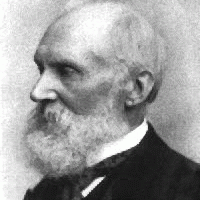
A major, late-19th century opponent of the ?solar origins? idea for aurora was the influential Scottish physicist Lord Kelvin (1824?1907). William Thompson Kelvin was a man of incredible self-confidence, and is responsible for more outlandish utterances and pronouncements than most scientists of his time would probably be comfortable making in public…And people believed him!
The tendency began as an undergraduate. His ego provided no option for him than to consider himself First Wrangler at Cambridge long before the results of the qualifying Tripos exam were even known. Legend has it that after taking the exam he asked his servant, “Oh, just run down to the Senate House, will you, and see who is Second Wrangler.” The servant returned and informed him, “You, sir!”.
Another example of his hubris is provided by his 1895 statement “heavier-than-air flying machines are impossible”. Kelvin is also known for an address to an assemblage of physicists at the British Association for the Advancement of Science in 1900 in which he stated, “There is nothing new to be discovered in physics now. All that remains is more and more precise measurement.”
Although he was the discoverer of Absolute Zero and a number of important concepts in thermodynamics, some of his detailed calculations turned out to be wrong in other areas. For instance, he calculated the age of the sun as 100 million years. This meant the sun was much younger than geologist Lyell or biologist Charles Darwin required in order to shape mountains and evolve species of life on Earth.
Arguably by some accounts, Lord Kelvins contribution to auroral science was to destroy the credibility of the Norwegian physicist Kristian Birkeland (1867-1917) who had created one of the best, and most modern, theories of solar-terrestrial influences of the time.
In 1898, Birkeland came up with the idea that beams of particles from solar sunspots were striking Earth and causing the aurora to glow. In Europe, Birkeland was widely regarded as having made a fundamental breakthrough to understanding why it was that some sunspots seemed to trigger aurora. Lord Kelvin believed, without proof, that magnetic energy from the Sun could not possibly produce influences at the distance of the Earth.
In Britain, the Royal Society was the prevailing stamp of approval for scientific thinking. Because Lord Kelvin was an influential figure at the Royal Society, his view of the impossibility of solar interactions with Earth was upheld through several generations of the Societys leaders. This had the chilling effect that Birkeland was, largely, dismissed as a crank by one of the most influential groups of physicists in the world. Worse still, his accomplishments disappeared from view in the scientific journals in the English-speaking world.
Bibliography
Campbell, D. M. and Higgins, J. C. (Eds.). Mathematics: People, Problems, Results, 3 vols. Belmont, CA: Wadsworth International, 1984. And http://scienceworld.wolfram.com/biography/Kelvin.html
Lucy Jago The Northern Lights 2001 Alfred A. Knopf Press)
Submit your review | |