
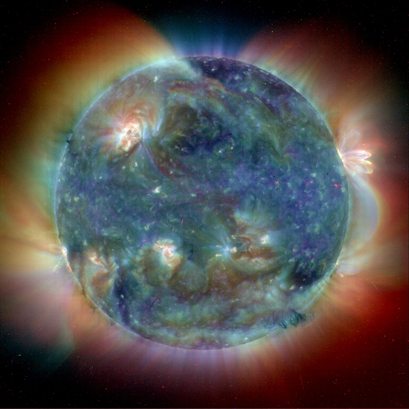
Space weather has a long history because it spans the life of the sun and earth, and the significant changes that have occurred between these bodies over the course of billions of years. Here is a convenient timeline of the key events in this history.
Many of these items will eventually be tied to additional pages where you will find more details about them by clicking on the [More] link.
PDF version 1.0 – PDF-Timeline.
13.4 billion years – Universe formed with hydrogen and helium: the basic elements of the sun
12.5 billion years – Formation of Milky Way nearly completed: Heavy elements created
4.58 billion years – Most consistent age for formation of sun
4.54 billion years – Age of Earth
4.4 billion years – Sun stabalizes as a star with only 70% current brightness
3.5 billion years – Earth day is 15 hours long
3.0 billion years – Oldest ‘fossil’ record of Earth’s magnetic field
3.0 billion years – Sun grows in brightness to 80% of current level.
900 million years – Length of day is now 18 hours long.
500 million years – Solar luminosity only 6% less than today.
300 million years – Solar luminosity only 3% less than today.
100 million years -Earth’s magnetic field three times stronger than today
780,000 years – End of last magnetic reversal : The Brunhes Isochron.
2,134 BC – Two Chinese astrologers beheaded because they failed to predict a solar eclipse
2,000 BC – Chinese report aurora sightings
1,600 BC – Sun disk and star map created in Germany
1,375 BC – First solar eclipse recorded in Babylon.
1,111 BC – First naked-eye solar flares possibly sighted by Chinese
800 BC – First sunspots sighted by Chinese
763 BC – Solar eclipse mentioned in Old Testament
467 BC – Anaxagoras possibly sees a sunspot.
37 AD – Julius Caesar sends troops to persue an ‘aurora’ seen in the north.
93 AD – Description of aurora as ‘meteors’ in Scotland
500 AD – First report of naked-eye sunspot by Chinese
513 AD – Report of naked-eye sunspot by Chinese
786 AD – Report of naked-eye sunspot by Chinese
807 AD – Report of naked-eye sunspot by Chinese
887 AD – Report of naked-eye sunspot by Chinese
925 AD – Report of naked-eye sunspot by Chinese
968 AD – First report of solar corona seen during total solar eclipse
1118 AD – Report of naked-eye sunspot by Chinese
1128 AD – First sketch of sunspot sighted in England
1138 AD – Report of naked-eye sunspot by Chinese
1185 AD – First sighting of solar prominence by Russian observers
1235 AD – North England auroral sighting mentioned in Holinshed’s Chronicle
1250 AD – Mention of aurora in Norse chronicle ‘Kings Mirror’
1290 AD – Wolf Sunspot minimum and vanishing of aurora
1381 AD – Report of naked-eye sunspot by Chinese
1436 AD – Report of naked-eye sunspot by Chinese
1440 AD – Sporer Sunspot Minimum
1600 AD – William Gilbert describes earth magnetism in ‘De Magnete’
1609 AD – Galileo uses telescope to study solar surface and sees sunspots.
1619 AD – Report of naked-eye sunspot by Chinese
1621 AD – Pierre Gassendi first uses the term ‘Aurora Borealis’
1624 AD – Report of naked-eye sunspot by Chinese
1638 AD – Report of naked-eye sunspot by Chinese
1645 AD – Maunder Sunspot Minimum starts
1715 AD – Earliest sketch of solar corona
1716 AD – Dramatic aurora seen in England
1722 AD – George Graham discovers that compass needle always in motion.
1726 AD – De Mairan is first to measure auroral heights.
1740 AD – Anders Celcius and Olof Hoiter discover magnetic storms
1770 AD – J. Wilcke discovers that aurora aligned with magnetic field of Earth,
1777 AD – Mairan proposes aurora caused by earth entering Zodiacal light
1833 AD- John Ross proposes aurora are light reflected from polar ice and snow
1848 AD – Auroral ‘earth currents’ disrupt telegraph lines worldwide
1851 AD – Heinreich Schwabe discovers the 11-year sunspot cycle
1856 AD – Edward Sabine discovers aurora connected to sunspot cycle
1856 AD -Dennison Olmstead concludes that aurora are caused by events external to earth.
1859 AD- Visible solar flare sighted by Carrington and Hodgson.
1860 AD – Elias Loomis maps out the auroral oval zone on earth.
1860 AD – Coronal Mass Ejection first spotted during a total solar eclipse
1867 AD – Anders Angstrom uses spectroscope to study aurora
1872 AD – Great Aurora seen in India, Cuba, Paris..
1879 AD – George Ellis offers first space weather forecast
1881 AD – Prof. De La Rue creates artificial aurora in a vacuum tube.
1882 AD – Henry Draper studies with spectroscope. Reveals line spectrum, not incandescent gas.
1882 AD – Balfour Stewart proposes that upper atmosphere is location for auroral currents.
1885 AD – Sophus Tromhole first to photograph aurora
1889 AD – Veeder discovers that major aurora can reoccur every 27-days
1892 AD – George Ellery Hale invents the spectroheliograph to study solar flares.
18xx AD – Stormer photographs aurora and determines heights of 12,000.
1894 AD – Great Aurora
1898 AD – Kristian Berkelund proposes electrical rays from sun cause aurora
1902 AD – Kennelly and Heavyside propose ‘ionosphere’ layer
1908 AD- George Ellery Hale detects intense magnetic fields near sunspots
1908 AD – Great Aurora
1909 AD – Birkeland creates a Terella to mimic aurora
1915 AD – Wireless outage in Northern Europe influences World War I
1918 AD – Sydney Chapman describe magnetic field of sun and earth as a system.
1919 AD – Whistlers heard for first time in World War I.
1920 AD – Great Aurora
1921 AD – Major aurora seen world-wide.
1923 AD – Babcock and McLennan identify auroral ‘green’ light as an oxygen line.
1925 AD – Beginning of studies of short-wave disruptions
1925 AD – Appleton and Barnett detect the ionosphere layer
1926 AD – Great Aurora
1934 AD – Hale publishes detailed study of solar flares and magnetic disturbances
1937 AD – The term ‘solar flare’ appears for the first time in Washington Post newspaper.
1938 AD – Great Aurora
193x AD – Bartels devises a method for cataloging magnetic storms.
1939 AD – J. Dellenger describes how solar flares cause short-wave radio outages.
1939 AD – Proton aurora discovered.
1940 AD – Easter Day shortwave disruption affects millions of phone calls.
1941 AD – Major shortwave disruptions during World War II activities.
1943 AD – Sunspots hamper radio transmission of Allied invasion of Italy on September 3.
1942 AD – S.E. Forbush detects ‘GLE’ radiation burst from a solar flare.
1947 AD – World-wide radio blackout. Airlines affected in Ireland
1947 AD – Giovanelli proposes that solar flares related to solar magnetic changes.
1949 AD – Reber detects radio burst before flare is detected by telescopes.
1951 AD – L. Biermann discovers solar wind using comet tails
1953 AD – Dungey proposes that flares caused by opposing magnetic fields on the sun.
1956 AD – P. A. Sweet proposes flares originate in magnetic activity above sunspots.
1957 AD – Waldmeier discovers coronal holes
1957 AD – Hannes Alfven proposes that the solar wind was magnetized.
1957 AD – World-wide radio fadeout lasts several hours on April 16th.
1958 AD – Van Allen Belts discovered by Explorer I satellite.
1958 AD – Severny proposes magnetic shock wave theory of flares.
1958 AD – AD Eugene Parker predicts solar wind should exist
1959 AD – Shortwave blackout over North Atlantic on March 29th.
1959 AD – Mariner 2 spacecraft detects the solar wind
1960 AD – Gold and Hoyle: energy released in a flare previously stored in magnetic field.
1960 AD – Moreton observes flare explosion produces waves in the solar atmosphere.
1961 AD – Magnetopause boundary detected by Explorer 10 spacecraft.
1962 AD – Warwick discovers Polar Cap Absorption related to 10 million-Volt particles.
1963 AD – Eugene Parker calculates how magnetic reconnection might work in a solar flare.
1963 AD – Type IV radio flares are found to be related to proton acceleration.
1963 AD – Furth proposes a new process that leads to solar flares.
1964 AD – Petscheck concludes reconnection easily happens as fast as actual flare events.
1965 AD – AMPTE satellite detects the ring current
1966 AD – Fairfield and Cahill show magnetic activity determined by polarity of solar wind.
1967 AD – Alfven and Carlquist propose ‘current disruption’ process that act quickly.
1968 AD – OGO-5 satellite detects magnetic activity in the geotail region
1968 AD – Akasofu proposes that ‘magnetic substorm’ describe auroral changes
1968 AD – Bumba shows flares are common where two sunspot groups are merging.
1968 AD – Axford proposes a polar wind to replenish the plasmasphere
1968 AD – David Rust confirms that explosions occur in magnetic fields of sunspots.
1971 AD – Najita proposes hite light flares caused by bombardment of upper photosphere.
1971 AD – Lin and Hudson propose hard X-ray burst evidence for 100,000 volt electron beams.
1971 AD – Brown proposes flare model where electrical current flow down a magnetic loop.
1971 AD – OSO-7 satellite discovers ‘Coronal transients’
1972 AD – August 4 – Apollo 17 major flare. Could have been lethal if astronauts in space.
1974 AD – Altschuler shows coronal magnetic field changes drastically around a flare region.
1989 AD – March 8-13 Major solar flare, X15 – Quebec Electrical Blackout
2001 AD – April 2 – Solar flare X20 – major flare
2003 AD – November 4 – Major X28 flare ends major solar storm episode lasting 15 days
2003 AD – November 11 Solar flare reproduced under laboratory conditions.

Submit your review | |