
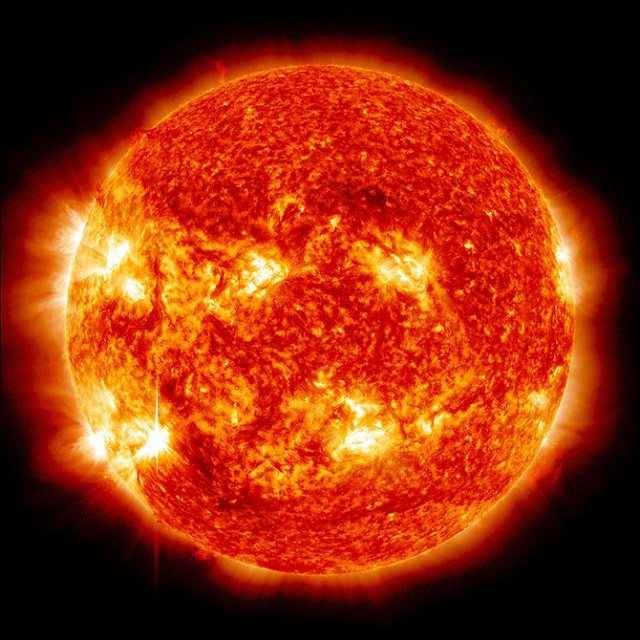
‘Cycle 23’ is certainly an odd-sounding title for a book. Chances are, without the subtitle “Learning to live with a stormy star”, you might think this is a book about a new washing machine setting, or some Hollywood expose. Instead, what you are going to find is a story about how we have misjudged what a “garden variety” star can do to us when we aren’t paying attention. Consider this: solar storms have caused blackouts that affect millions of people, they have caused billions of dollars of commercial satellites to malfunction and die; they may also have had a hand in causing a gas pipeline rupture which killed 500 people in 1989. Despite this level of calamity, the odds are very good that you have never heard about most of these impacts, because they are infrequent, the news media does not make the connection, and there are powerful constituencies who would just as soon you not hear about these kinds of ?anomalies?.
For over 150 years, telescopic views of the sun’s surface have revealed a rhythmic rise and fall in the number of sunspots. Each cycle lasts about 11 years from ‘sunspot maximum’ to ‘sunspot minimum’, and in-step with this, scientists have found many other things that keep a rough cadence with it. The Northern and Southern Lights (aurora) are more common during sunspot maximum than minimum. Titanic solar flares brighter than a million hydrogen bombs also come and go with this cycle. But there is a darker side to these events. Solar flares can kill, aurora can cause blackouts, and satellites can literally be forced out of the sky.
My own professional contact with solar activity came in the 1990’s when a change in my working circumstances found me confronting the various hob-goblins of ‘space science’ for the first time since graduate school. These kinds of changes are usually a wake-up call for most people, but for me it meant that a 15-year research program in infrared astronomy had come to an end. NASA’s COBE satellite program ended in 1996, and so did much of my research for a variety of complicated reasons. For the first time, I found myself with only enough grant money to support my career as an astronomer for eight hours a week. In my case, the sun’s talent for raising havoc became something of a professional life preserver.
Very luckily, NASA had just given the go-ahead to James Burch at Southwest Research Institute in San Antonio Texas, to begin work on the Imager for Magnetopause-to-Auroral Global Exploration (IMAGE). It was a satellite that would orbit the earth and keep watch on the movement of energetic particles as the sun “threw its various tantrums”. Although they didn?t have much use for an astronomer, they did have funds to set up an education and public outreach program. This program would be handled by Raytheon’s Information and Technical Services Maryland division: my employer. It didn’t take long before William Taylor, who was the Director of the IMAGE education and outreach effort, hired me to help turn their proposed program called POETRY (Public Outreach, Education, Teaching and Reaching Youth) into a real flesh-and-blood education program for students, teachers and the general public.
I began to realize that space science was a very long way from the kind of astronomical research I had been doing for the last 15 years. I was most unfamiliar with the science, and I had hardly a clue about how to capture the public’s imagination in an area I regarded as rather far removed from the public’s mind. It had nothing to do with gravity, black holes, cosmology or the topography of the Milky Way. It had everything to do with magnetism, the sun, and invisible processes operating around the earth.
And now I have a confession to make.
Hardly any astronomer I know really enjoys space physics of the kind involved in studying the sun-earth system. Before the Space Age, space science was an area of research not many young astronomers found much stimulation in. The excitement of exploring how stars evolve, and the structure and contents of the universe, was a much more potent draw of attention and enthusiasm. Solar and space research was often seen as too local, and it was intellectually very messy physics to boot. In these areas of physical science, the simple relationships and mathematical formulations of Isaac Newton’s Universal Gravitation were almost irrelevant. The particles and winds that blow from the sun are a charged plasma which drag with them magnetic fields. The geospace environment is another system of plasma and magnetic fields distinct from the sun, but nevertheless electrically connected to it by the solar wind. The relevant principles in physics that have to be mastered are not those of Newton’s gravity. Instead it is James Clerk Maxwell’s electrodynamics that take center stage. Currents and fields coexist in complex equations sprouting curlique letter ‘d’s and inverted triangles – the machinery of vector differential calculus. Because plasmas contain charged particles, they interact through electromagnetic forces trillions of times stronger than gravitational ones. Clumps of plasma in one part of the system can interact with other distant ones, and produce complex collective interactions and patterns of motion. The currents spawned by these motions generate their own magnetic fields, which can modify already existing ones in remote corners of the system. Very ugly stuff to the average astronomer! Because of this professional bias within the astronomical community, you probably know more about the subtleties of Big Bang cosmology whose key event happened 15 billion years ago, or Europa’s subsurface sea, than you do about what the sun is doing right now. The irony is, however, that while you will never have to worry about quasars and supernovae ruining your day, you may have cause to worry about the next big solar flare!
In the middle of trying to master decades of research in unfamiliar corners of space physics, I stumbled upon a remarkable, personal, discovery. Here and there, I found mixed-in with the physics, brief references to the impacts that these processes have on our technology, and ourselves. Blackouts? Satellite malfunctions? Radio interference? What was all this stuff?
Astronomers have always worked in an arena in which virtually all of what we study has zero impact on individual human lives. The closest astronomers ever come to having a direct human impact is when we explain the lunar and solar tides that are the blessing of surfboarders around the world, or the constancy of the sun’s light and heat. When we discuss astronomical research with the general public, we write about black holes and the Big Bang, filling them with awe and wonderment. But we knew full well that this is about as far as we can go in touching upon the practical benefits of research. Fortunately, the general public also values these insights, and like astronomers, they find the exploration of space an endlessly fascinating story. So all is well.
But now my perspective has changed. What I discovered (and what space scientists had never forgotten in the first place) was that the sun gives us far more than just a lovely sunny afternoon. Something called ‘solar storms’ can leap out from the sun and unleash a cascade of events from one end of the solar system to the other. Reaching earth, they make intimate contact with everything from the light switch on your wall to that pager or cellphone you carry in your pocket. They can paint the sky with dazzling color, plunge millions of people into darkness, or rob them of their freedom to communicate.
Here, amongst the complex calculus of plasma physics, I came into contact with a dramatic world of things moving in darkness; of human impacts; of calamity. For the first time in my professional life, sterile equations in astrophysics came alive with measurable human consequences. A flow of particles in one place could ‘toast’ a satellite and silence 45 million pagers. A similar current elsewhere could cause an ephemeral aurora to dance in the sky and make you gasp in wonderment.
So where was the literature on all of these impacts? Why had I never heard about this before in all of my daily readings about frontier science? The reason is that it was tucked away among countless anecdotes, papers, books and newspapers like filler, serving only to enliven long expositions on the underlying physics of aurora, or solar physics. Much of it was also out-of-date and hackneyed as author after author rehashed the same three or four spectacular incidents. Yet I had never heard of any of these examples of astrophysics made personal, and each one was uncovered like a diamond sifted from the river silt. Very soon, though, I had accumulated a bucketful of these diamonds, and it was now time to make sense of what I had found. The human impacts were not scattered events in space and time; they were a legacy, written in our very technology, of work left undone, and problems endlessly repeated, which have dogged us for centuries. Hearing about these incidents, was like hearing for the first time about tornadoes, and then trying to collect reports of their various comings and goings.
Eventually, as I moved among researchers in space science, I encountered a most curious undercurrent of hushed comments and anecdotes that seemed just a trifle too melodramatic. Could it really be true that satellite manufacturers didn’t want scientists to reveal just how vulnerable their satellites were to solar storms? Was NASA really trying to downplay scientific studies of satellites being ‘killed’ by space weather events? Could space-suited astronauts really be in more danger for radiation poisoning than anyone wanted to publicly admit? The list seemed endless, and the implications seemed a bit more distressing than anything an astronomer might ever encounter in writing about dark matter or the cosmological constant. Physics and space science seemed to be in bed with the darker side of human foibles in any accounting one wanted to do, to describe how space physics affects the individual. Would it be possible, or even desirable, to present only the facts shorn of their implications, both political and economic?
Space weather, as I soon learned it was called, touches more than just sterile technology. This technology is built by humans for many different commercial and military purposes. With every report of an impact, a protest, or denial would be pronounced, or an accusation of ineptitude or intentional wrongdoing. At first I could see no way out of it. It would not be possible to mention a problem spawned by adverse space weather without giving the impression that the owner of the technology had been asleep at the switch or profoundly naive. It would not be possible to mention human radiation exposure without sounding alarmist, or implying between the lines that an agency was negligent in assessing actual health risks.
There is, however, a way to present the human impacts of the space weather in a way that tells the story, but allows it to provide its own interpretation. Like a nuclear pile, the individual components are inert until they are brought together into a critical mass to trigger the fusion process.
We are going to see that the long-arm of the Sun can reach deep into many unsuspected niches of our technological civilization, causing blackouts, satellite problems or pipeline corrosion. Navigation systems that rely on compass bearings can become temporarily confused by ?magnetic storms?. Short wave signals have routinely been blacked out for hours rendering long distance communication and LORAN navigation beacons useless or unreliable. Even the atmosphere itself can become our own worst enemy, dragging satellites to a fiery doom.
Each time a major solar flare erupts, we are momentarily barraged by a cone-shaped beam of high-speed neutrons which fan-out towards the ground and penetrate our bodies, our airplanes, our homes, and our most advanced technologies. Even the advancing tide of computer technology may be hampered by them, as chips become smaller and more easily activated by passing charged particles.
So, why should we care that we are now once again living under ‘sunspot maximum’ conditions during Cycle 23? After all, we have already weathered at least five of these solar activity cycles since the end of World War II, and a nearly a dozen in the 20th Century alone. What is different about the world today is that we are substantially more reliant upon computers and telecommunications to run our commerce, and even our forms of entertainment and recreation. The 15 communications satellites we had in 1981 have been joined by 350 in 1999. Cellphones, PCs and the internet became an overnight $100 billion industry. To support all of this, not only will we need more satellites, but we will need more electricity flowing in our power grid which will have to work under loads unheard of in the past. As voters continue to elect not to build more power plants, even the National Energy Research Council forecasts that blackouts and brownouts will become more common as power companies run out of temporary sources of power to buy during peak-load conditions during the summer and winter.
It is common to base future expectations on recent past experiences: “Past is prologue” some say. Increasingly, these past experiences with, for example, commercial space technology and electrical power technology, do not extend back much beyond the last solar maximum in 1989-1990. So, when we wonder why infrequent events such as solar storms aren’t more noticeable, we have to remind ourselves that most of our experience comes from times when the sun was simply not very active, we were a lot less technologically vulnerable, and there were far fewer consumers involved in the vulnerable technologies.
Now more than ever, we depend on uninterrupted sources of power. Blackouts are amusing for about the first 60 seconds, then become intolerable. We have become dependent on our cell phones and pagers in a way that will tie critical moments in our private lives to the shotgun physics of satellite and power grid survival during invisible solar storms. When a single failed satellite can pull the plug on 45 million pagers, do we find ourselves more secure? Sometimes it can be dangerous and costly to gamble, although most of the time we seem to get by with hardly realizing that we have been laying golf in a thunderstorm. There is also a disturbing tendency to deny that risks warrant any action given their rarity and unpredictablness. In both the electrical power industry and in the satellite business, certain ventures are not publicly acknowledged as inherently risky and intrinsically susceptible to solar and geophysical influences.
Although no one can say for sure how current trends are going to play themselves out in the next 5-10 years, the evidence for how we have already been affected in the past is well documented. It all comes down to the simple fact that the sun is not the well-behaved neighbor we would like to imagine it to be. It pummels us every few days or weeks with dramatic storms launched from the surface at millions of miles per hour. Between the solar surface and the earth’s surface, all of our technology and human activity plays itself out between a rock and a hard place. In most cases, we can not even tell when the next blow is likely to fall. But there is no great mystery about what is going on. We have had a long history, spanning a century, of calamities spawned by solar disturbances. It is from this record that we can begin to see what problems may be lurking just around the corner. As the sun continues to cycle up and down some 22 times since the 1800’s, the confluence of technological innovation and human commercial necessity now finds us at greater risk for trouble during this, the 23rd Solar Cycle, than in many previous ones. What has changed is the level of our reliance upon sophisticated technology, and its widespread infiltration into every niche of modern society. What has not changed is our possibly misplaced sense of confidence that this too will pass with no real and lasting hardship. The issue is not who is responsible for today’s suite of vulnerabilities, but what they are preparing to do about them from this moment onwards.
The writing of a book such as this was an exciting process, made even more so by many people who helped me understand the dimensions of this subject, and express it clearly. I would like to thank Richard Vondrak, Project Manager for the NASA, ISTP program, for kindly reading a number of chapters having to do with NASA missions and the National Space Weather Program. I also thank George Withbroe, Director of NASA’s Office of Space Science, for explaining NASA’s ‘Living with a Star’ program, and for letting me use his personal anecdote mentioned in Chapter TBD. I also thank John Kappenman for teaching me about the electrical power industry and GICs. I would like to thank Art Poland, Eric Christenson and Tycho von Rozenveinge with the SOHO and ACE satellite projects, for their insight into how these ISTP missions operate. I also thank James Burch, Bill Taylor and Jim Green with the IMAGE satellite project for many conversations about space weather issues and IMAGE science objectives. Barbara Thompson, E. Stassinopoulos, Michael Lauriente and Barbara …. at the Goddard Space Flight Center were most helpful in explaining to me how individual researchers in space science receive their funding, and how radiation mitigation issues are being investigated…. …. at International Broker Services was very helpful in describing the way that satellite insurers operate, which for me dispelled several important misconceptions. I would like to especially thank Holly Hodder at Columbia University Press for her continued enthusiasm about this project, and the many excellent suggestions she made in helping me organize this material to make it readable. I credit her with the wonderful idea of concentrating on a few major examples, rather than attempting an encyclopedic summary of every outage and mishap. Last, but most assuredly not least, I have to thank my wife, Sue, and my daughters Emily Rosa and Stacia Elise, for all the early morning hours we sacrificed before breakfast to finish the manuscript.
Submit your review | |