
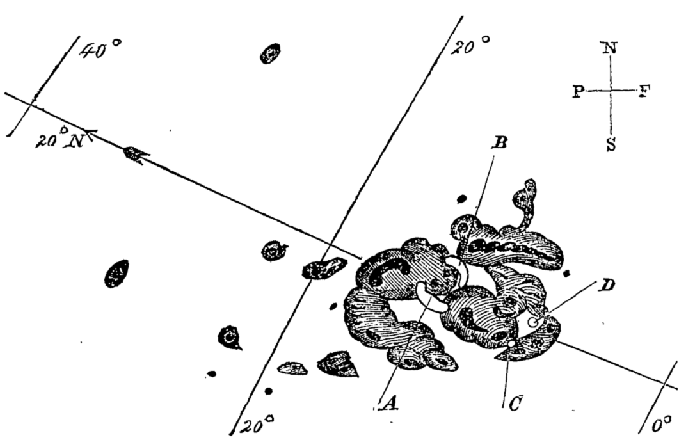
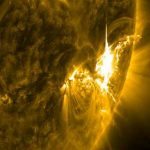
August 28 – September 2, 1859 – The Storm of 1859 was the first event recorded by humans from a truly global perspective, not to be repeated until the eruption of Krakatoa in 1883 turned the sunsets red and crimson the world-over. Newspapers such as the New York Times were active in running extensive stories about the 1859 solar storm, and collecting reports from other countries. The great geomagnetic storm of 1859 is really composed of two closely spaced massive worldwide auroral events. The first event began on August 28th and the second began on September 2nd. It is the storm on September 2nd that results from the Carrington-Hodgson white light flare that occurred on the sun September 1st. (Drawing by Carrington of flaring sunspot)
Articles found:
“The Aurora Borealis”-From twilight until ten o’clock last night the whole heavens were lighted by the aurora borealis, more brilliant and beautiful than had been witnessed for years before.The light streaks shot upwards from the horizon and varied in width and length, and changed as long as the phenomenon was visible. It was a grand sight, and was witnessed by thousands of persons, many of whom never saw the like before. [The Baltimore Sun, , 1859, p.1 ]
A brilliant display of Northern lights was witnessed from 8 o’clock to half-past 9 last night. The glare in the northern sky, previous to defining itself into the well-known features of the Aurora Borealis was sufficiently vivid to call out some of the fire companies. [The Evening Star (Washington DC]
‘The City’ Change of Weather ‘Towards half past eight o’clock a singular phenomenon took place. The horizon from north to north east became of a deep crimson hue, which expanding slowly, made the sky appear as if lighted by a Bengal fireAt first it was supposed that some great conflagration had taken place on the outskirts of the city, but it was soon recognized that no natural firs could produce this particular hueCrowds of people gathered at the street corners, admiring and commenting upon the singular spectacle. Many took it to be the sign of some great disaster or important event, siting numerous instances when such warnings have been given. Several old women were nearly frightened to death, thinking it announced the end of the world, and immediately took to saying their prayers. A fat old citizen tremblingly stated that this was the avant courier of a dreadful epidemic like cholera of 1833, whilst a French gentleman pooh-poohed, and gravely assured us that this was the well known sign of a revolution in Paris, requesting us to make a note of the date. [New Orleans Daily Picayune, p.5]
“Aurora Borealis” – Early this morning, between twelve and one, a most brilliant display of the above phenomenon was observed extending from the western hemisphere to the north-west, north and north-east, and reaching to the zenith. The appearance in the west was that of a large fire, but in the north and north-east it was of a violet colour, and with great brilliancy. This beautiful display lasted for about an hour, and then gradually died away, leaving a serene and unclouded autumnal sky. [The London Daily News. P. 2, ]
“Aurora Borealis” – For the first time in several years we had last night a grand exhibition of the ‘Northern Lights’. The first appearance was at five minutes past nine o’clock as told by the fire watchman on the roof of the City Hall. The greatest illumination was at about twenty minutes before ten o’clock, when the light was so brilliant that it shone on Telegraph Hill and the upper story and cupola of Wright’s building like the reflection of an extensive conflagration. The light, or rather columns of light, were of a deep red hue, and at one time extended from the horizon almost to the zenith. It was a magnificent sight – quite superior to the Chinese fire exhibitions in the theater.[[San Francisco Daily National p. 2]
‘Local Matters’, The aurora borealis gave on Sunday night one of the most brilliant exhibitions ever observed in this latitude by the oldest inhabitants. The display commenced at soon after eight o’clock in the evening, and continued..till daylight.Altogether it was an unusually interesting specimin of a phenomenon as yet imperfectly understood. It left us a pleasant and bracing northwest wind and ushered in a beautiful day. [Washington Daily National Intelligencer, p.1]
Singular Effect of the Uarora Borealis on the Telegraph Wires. New York. August 29, The Superintendent of the Canadian Telegraph Company’s line telegraphs as follows in relation to the effect of the Aurora Borealis last night: ‘so completely were the wires under the influence of the Aurora Borealis, that it was found utterly impossible to communicate between the telegraph stations, and the line had to be closed.’ The same difficulty prevailed as far South as Washington. [Chicago Tribune, p.4]
Aurora Borealis. Yesterday morning a most brilliant display of aurora borealis was visible from soon after twelve o’clock until daylight. Vivid streams of light shot up from the horizon in the north, extending from east and west, which were at times red, and presented the appearance of the reflection from a large fire. The atmosphere was so strongly illuminated that it appeared as if the moon were shining, and rays of light, resembling the rays from the sun as reflected upwards from the back of a cloud, continued to be brilliantly visible during the whole time. The sky was remarkable clear, and the stars shone with as brilliancy that is unusual even in winter. [The London Morning Post, p. 3.]
The Northern Light. Sunday evening our citizens witnessed a beautiful Aurora Borealis. The whole northern havens[sic] were illuminated with brilliant radiations of different colored lights. The streets were lighted up quite bright by them, and the spectacle was a splendid one. [Daily Morning News – Davenport Iowa, p. 1]
The Aurora Borealis : The Brilliant Display on Sunday Night, The present generation have listened with wonder and admiration to the stories their fathers and mothers have told them of auroras and meteors. They have opened their ears and mouths and eyes as they heard of stars falling from the heavens like rain, of the sky at night becoming read as with blood, and imn the day time of its being so darkened that stars were visible. Few have had the opportunities of witnessing these sublime displays; but on Sunday night the heavens were arrayed in a drapery more gorgeous than they have been for yearsSuch was the aurora, as thousands witnessed it from housetops and from pavements. Many imagined they heard rushing sounds as if Aeolus had let loose winds[The New York Times, ]
‘The Electrical Light’ [exerpted from the New York Express] The light in the heavens on Sunday night is noted in all directions..The crown above, indeed, seemed like a thrown of silver, purple and crimson being and spread out with curtains or wings of dazzeling beauty. Never did the heavens seem to be more the work of the Creator, nor the sublimest work of art sink in comparison so far beneath the wondrous skill and power of the Architect of the Heavens. The tremulous motion of moving light, which the inhabitants of the Shetland Islands call the ‘merry dancers’ was less apparent than usual, but in place of it came those, full, bright, changing, but more steady streams of light, which gave the intense brilliancy to the whole heavens. [Washington Daily National Inteligencer, p.2??,]
Northern Lights. On Sunday evening the 28th there was a beautiful and grand display of aurora borealis which lighted up the northern hemisphere majestically and caused many inquiries in the mind of those who witnessed the phenomenon as to the cause which produced it. Much has been said and written on the subject by men who consider themselves learned and wise, but no one unaided by the light of eternal truth, has been or ever will be able to solve the apparent mystery of these remarkable appearances in the heavens, which as many believe, never occurred till after the Ten Tribes of Israel went into the north countries. [The Deseret News, Salt Lake City, p.1]
Luminosity and Electricity in the Sky. The heavens were brilliantly illuminated about midnight on Sunday in this neighborhood, says the Manchester Guardian, by a mass of white rays or streaks, completely suffused with a vapor of a pink or dark roseate hue, through which brightly shone the stars, presenting a most beautiful appearance, and being far more deeply coloured than the aurora borealis is to be seen in this region. The phenomenon, as seen in Cheale, Cheshire, was sufficiently luminous, notwithstanding some overspreading clouds, to permit the reading of print letters 1-8th of an inch in sizeat the zenith a bright and perfect radiation appeared, which extended, slightly interrupted by cloud, a great distance towards every part of the horizon, whilst amongst the rays incessantly played sheet lightning, rendering this the grandest spectacle of that period of the night. [London Morning Post, p. 5.]
The Aurora Borealis. Our exchanges very generally speak of the Aurora Borealis which came off on Sunday night last, and unanimously agree in opinion that it was superior in extent and brilliancy to anything of the kind that has been seen in this country for many years. The Superintendent of the Canadian Telegraph Company’s lines telegraphs as follows in reference to it: ‘I never, in my experience of fifteen years in the working of telegraph lines, witnessed anything like the extraordinary effect of the Aurora Borealis between Quebec and Farther Point last night..’ [The Evening Star p. 3, ]
On Sunday evening (in Vermont), the 28th ult., at seven and a half o’clock, we were notified of a large fire behind the mountain at the north, and we went out to see it: and presently the red clouds began to disappear, and spires of green shot up from the same place. It was the most magnificent display ever witnessed in this section; the sky for about an hour more kept changing from green to red, till ten and a half o’clock, when all the brilliancy was gone, except a little green at the north[Boston Transcript, Monday, September 5, 1859].
The sky was completely overarched at one time, and then the entire firmament presented a gorgeous spectacle, as the jets of light streaming up from all quarters were of different hues[Boston Daily Evening Transcript, Monday evening, August 29, 1859].
At all events, we know of no known cause that would produce such celerity of motion as these merry dancers seemed to have, unless it be galvanism and not electricity[Boston Transcript, Monday, August 29, 1859].
The Aurora Borealis seen from the summit of Mount Washington on the night of the 25th of August, 1853 [sic], was next morning followed by an atmosphere so clear that the spires of the churches at Portland, 95 miles distant, were distinctly seen from the summit of the mountain, and at the same time a most brilliant meteoric shower was seen from the ocean near the equator[Boston Transcript, August 30, 1859].
At one time the northern portion of the heavens assumed an almost blood red appearance, while here and there long streaks of light shot up from the horizon to the zenith. These rapidly changed their place and their form until they extended over the greater part of the sky, breaking through the reddish hues and finally covering nearly the whole face of the heavens[New York Herald, August 29, 1859].
Objects at a distance could be more readily and clearly distinguished than when the moon is at its full. Now vivid arrows of light of most exceeding brilliancy shot up from the whole northern horizon; and, retreating, would again shoot higher and higher, until they covered the whole sky. This continued to grow darker, first to scarlet, then to crimson, and finally to the blood-red like appearance of an immense conflagration. The whole sky appeared mottled-red, the arrows of fire shooting up from the north, like a terrible bombardment, of which we could see all and hear none, while the stars of greater magnitude shone through like sentry lightsCorrespondence of the Journal of Commerce, Cleveland, Ohio [Washington Daily National Intelligencer, Friday, September 2, 1859].
was of extraordinary brilliance. There was a ghastly splendor over the horizon of the North, from which fantastic spires of light shot up, and a rosy glow extended, like a vapor tinged with fire, to the zenith[Cincinnati Daily Commercial, August 29, 1859].
The light appeared in streams, sometimes of a pure milky whiteness and sometimes of a light crimson. The white and rose-red waves of light as they swept to and from the corona were beautiful beyond description, and a friend near by us, while looking to the zenith with the whole heavens and earth lighted up at a greater brilliancy than is afforded by the full moon, said that it was like resting beneath the wings of the Almighty. The crown above, indeed, seemed like a throne of silver, purple and crimson, hung and spread out with curtains or wings of dazzling beauty. The tremulous motion of moving light, which the inhabitants of the Shetland Islands call “the merry dancers,” was less apparent than usual, but in place of it came those full, bright, changing, but more steady streams of light, which gave an intense brilliancy to the whole heavens[Washington Daily National Intelligencer, Wednesday, August 31, 1859].
During the first display the whole of the northern hemisphere was as light as though the sun had set an hour before, and luminous waves rolled up in quick succession as far as the zenith, some a brilliancy sufficient to cast a perceptible shadow on the ground[The Times London, September 6, 1859].
Some who saw the display attributed it to fires in the towns about[Rochester Union & Advertizer NY, Friday, September 2, 1859].
About 10 [PM] a tremulous flashing up from the east was observed – soon after a bank-like arc of a circle was seen in the North, below which, the appearance was very somber, resembling a very dark cloud. From this arc soon shout [sic] up columns of light toward the zenith. This was immediately succeeded by the most lively and brilliant succession of flashes, forcinbly [sic]reminding one of that prophetic scene described by St. Peter, whose language is – “Wherein the heavens being on fire shall be dissolved, and the elements shall melt with fervent heat.” This grand and sublime exhibition was succeeded by another brilliant display of columns of light shooting up again from the arc, with a slight show of the merry dancers. Soon after this the light gradually faded and ceased to attract much notice[Boston Transcript, Saturday September 2, 1859].
When first seen, the aurora omitted [sic] a thin pale light, which flashed up toward the center of the overhanging arch. Simultaneous with these flashes, long illuminated lines extended to the same point, which became redder and redder, till one assumed nearly a crimson color[Boston Transcript, Sat. September 3, 1859].
“The auroral light sometimes is composed of threads like the silken warp of a web; these sometimes become broken, and fall to the earth[Providence Daily Post, Rode Island, September 3, 1859].
There was another display of the Aurora last night so brilliant that at about one o’clock ordinary print could be read by lightBoston, Friday, September 2 [The New York Times, New York Herald, Washington Daily National Intelligencer, Friday, September 2, 3, 5, 1859].
It was reserved for our days to have a sage and philosopher to make clear to our comprehension the wonderful mysteries of those lights, which the Scotch know as merry dancersbut with which we are more familiar by their Latin name of aurora borealis, to show us that they are nothing more nor less than an industrial exhibition of the upper air, a silkery [sic] in the clouds, whereat the magic shuttle flies from horizon to zenith with a speed that leaves electricity lagging far behind, and to be prepared to exhibit to the incredulous world a piece of the product of these heavenly looms. Phenomena are not supposed to have any reference to things past — only to things to come. Therefore, the aurora borealis cannot apply to the battle of Solferino or the peace of Villaranca. It must be connected with something in the future — war, or pestilence, or famine. They may be connected in some way with volcanic eruptions, or earthquakes, or, as has been long supposed, with icebergs. As philosophers are unable to solve the problem, why do not the aeronaunts try it? Wise and La Mountain have been threatening transatlantic voyages. Suppose that, before they start for the other side, they would ascend in their balloons and try to get a glimpse of the foundation line of the aurora borealis[New York Herald, September 5, 1859].
Aurora appeared, illuminating the city so brightly as to draw crowds into the streets[New York Times, September 5, 1859].
But two hours later, when the light, as a whole, was at its greatest brilliancy, the northern heavens were perfectly illuminated, with the exception of a few dim and almost imperceptible white streamers, which passed from the zenith nearly half way down to the northstar [sic] . At that time almost the whole southern heavens were in a livid red flame, brightest still in the southeast and southwest. Streamers of yellow and orange shot up and met and crossed each other, like the bayonets upon a stack of guns, in the open space between the constellations Aries, Taurus and the Head of Medusa – about 15 degrees south of the zenith. In this manner – alternating great pillars, rolling cumuli shooting streamers, curdled and wisped and fleecy waves – rapidly changing its hue from red to orange, orange to yellow, and yellow to white, and back in the same order to brilliant red, the magnificent auroral glory continued its grand and inexplicable movements until the light of morning overpowered to radiance and it was lost in the beams of the rising sun[New York Times, September 3, 1859].
Early in the evening from the east there came a faint light, like that preceding the rising moon, while in the west a delicate crimson seemed to be thrown upwards, as if from the sun, long since gone down. Later, these strange fires overran the entire heavens — now separating into streamers, gathered at the zenith, and forming a glorious canopy – then spreading evenly like a vapor, shedding on all things a soft radiance; again, across the sky waves of light would flit, like the almost undistinguishable ripple produced by the faintest breeze upon the quiet surface of an inland lake; a pale green would now cover half the firmament from the east, while rich crimson met it from the west – then the ruddy light would concentrate itself at the zenith, while beneath it fell in folds of beauty the mild purple and green. To the east and to the west lay huge fields of luminous clouds, tinted with a bright rosy flush, wholly unlike that produced by the rising sun and if possible even more beautiful. Soon, as Everett has beautifully spoken of a somewhat similar scene, “the hands of angels shifted the glorious scenery of the heavens.” The mass of apparent, red cloud to the east moved away southward, gradually failing, while the corresponding red clouds on the west seemed to sink into a chaos of dark cloud that, with a fringe of blue, skirted the western horizon. – Sheets of the same white luminous cloud again illuminated the sky, producing about the same amount of light as the full moon, and the night became almost as the day. The aurora borealis is today the chief topic of conversation, and all agree that they have seldom or never witnessed so extensive and remarkable an atmospheric phenomenon[Cincinnati Daily Commercial, September 1, 1859].
Half-past eleven. The appearance now is positively awful. The red glare is over houses, streets, and fields, and the most dreadful of conflagrations could not cast a deeper hue abroad[San Francisco Herald, September 5, 1859].
The whole sky appeared to undulate something like a field of grain in a high wind; the waters of the Bay reflected the brilliant hues of the Aurora. Nothing could exceed the grandeur and beauty of the sight; the effect was almost bewildering, and was witnessed with mingled feelings of awe and delight by thousands. Nebulous matter, like that which furnishes material for meteoric showers, or the zodiacal light, and is known to exist in the planetary spaces, is probably the cause of these displays. He regards the light as emitted by the friction of the earth, plunging with its atmosphere, through this vapor, the velocity being sufficient, despite the rarity of the materials, to develop the luminosity[San Francisco Herald, September 5, 1859].
Large print could no doubt have been easily read, for we can testify that the time on the face of a watch was easily legible[Washington Daily National Intelligencer, September 3, 1859].
On Thursday night last about eleven o’clock our attention was attracted by the red appearance of the sky in the N. East, which we at first supposed was the reflection from a fire in that direction, but it began to spread on both sides and was pronounced by those who knew, to be the Aurora Borealis or Northern Light. About half past eleven it began to assume the appearance of day breaking and in an hour it was almost as light as day, the stars, which before shown brightly being invisible; at one o’clock the light began to fade and in an hour the heavens had assumed their usual appearance and the stars shown out bright as ever, and, turned in[Rocky Mountain Gold Reporter, September 3, 1859].
On the night of [September 1] we were high up on the Rocky Mountains sleeping in the open air. A little after midnight we were awakened by the auroral light, so bright that one could easily read common print. Some of the party insisted that it was daylight and began the preparation of breakfast. The light continued until morning, varying in intensity in different parts of the heavens, and slowly changing position. We can best describe it as the sky being overcast with very light cirrus clouds, wafted before a gentle breeze, and lighted up by an immense conflagration. It had rained for fifty hours before, only ceasing about twelve hours before the auroral light’ [Rocky Mountain News, September 17, 1859]
It is an indisputable fact that old topers, wholesale consumers of the alcoholic fluid, whose capacious stomachs could retain an enormous quantity of the “creature” without their heads or legs being in the least affected by it, have fallen dead drunk last night and last Sunday night, before they had imbibed their regular allowance, and through no other cause than the mysterious influence upon their system of the unexplained electrical phenomenon, shining overhead[New Orleans Daily Picayune, September 3, 1859].
The northern sky, for an extent of some forty five degrees, was luminous with a mass of red light, from whence shot up towards the zenith the usual streaks, at times vivid and beautiful[New Orleans Daily Picayune, September 3, 1859].
again appeared in most resplendent brilliancy in the northern horizon last evening, being visible for a while just before and after the hour of midnight. The fainter or yellow lines of upshooting light could be clearly distinguished in the bright red illumination which extended wide around, lighting up the sky in such a manner as led the unmindful and even some of the fire companies to suppose that part of the city was about to be burnt out in a grand conflagration[The New Orleans Bee, September 2, 1859].
Singular as it may appear, a gentleman actually killed three birds with a gun yesterday morning about 1 o’clock, a circumstance which perhaps never had its like before. The birds were killed while the beautiful aurora borealis was at its height, and being a very early species — larks — were, no doubt, deceived by the bright appearance of everything, and came forth innocently, supposing it was day[New Orleans Daily Picayune, September 9, 1859].
All our exchanges, from the northern coast of the Island of Cuba (from the southern side we have none so late,) come to us with glowing descriptions of the recent Aurora Borealis, which appears to have been as bright in the tropics as in the northern zones, and far more interesting. The sky was no more, or at least but for a moment, completely lit up from the horizon to the pole, but the light came and went, now here, now there, now in this direction, now in that, and each time varying in outline and brilliancy. During the three hours which followed it seems to have had almost every latitude and longitude possible in its field, and to have described every possible figure[New Orleans Daily Picayune,September 7, 1859].
.The French telegraph communications at Paris were greatly affected, and on interrupting the circuit of the conducting wire strong sparks were observed. The same thing occurred at the same time at all the telegraphic station in France[The Illustrated London News, September 24, 1859].
Never in my experience of fifteen years in working telegraph lines have I witnessed anything like the extraordinary effect of the Aurora Borealis between Quebec and Farther Point last night. The line was in most perfect order, and well skilled operators worked incessantly from 8 o’clock last evening till 1 this morning to get over in an intelligible form four hundred words of the report per steamer Indian for the Associated Press, and at the latter hour so completely were the wires under the influence of the Aurora Borealis that it was found utterly impossible to communicate between the telegraph stations, and the line had to be closed. The same difficulty prevailed as far south as Washington[Rochester Union & Advertizer, Tuesday Evening August 30, 1859].
The New York operator, J.C. Crosson, reported as follows: On Sunday evening last, at 7-1/2 o’clock, I experienced considerable difficulty in working on account of the variation of current. Upon looking out the doors I perceived broad rays if light extending from the zenith toward the horizon in almost every direction. I then concluded the difficulty arose from the mysterious influence of the Aurora Borealis[Cincinnati Daily Commercial, September 7, 1859].
The telegraph operators throughout the east report a very brilliant display of auroral light, which though very fine to look at, has as usual greatly hindered the transmission of messages over the wires[Philadelphia North American & United States Gazette, Monday Morning, Aug. 29, 1859].
Lousiville KY, August 31-The telegraph wires between this city and New York, as also throughout Canada, were interrupted by the unusual overcharge of electricity which always pervades the atmosphere during the continuance of this phenomenon[The New Orleans Bee, September 1, 1859].
The wire was then worked for about two hours without the usual batteries on the auroral current, working better than with the batteries connected. This is the first instance on record of more than a word or two having been transmitted with the auroral current[Washington Daily National Intelligencer, Tuesday, September 6, 1859].
Who now will dispute the theory that the Aurora Borealis is caused by electricity[Washington Evening Star News, September 2, 1859].
During the auroral display on Thursday night in Boston some curious phenomena were witnessed in connection with the telegraph wires. The following conversation, says the Boston Traveler, between the Boston and Portland operators on the American telegraph line, will give an idea of the effect of the Aurora Borealis, on the working of the telegraph wires: Boston operator, (to Portland operator)–“Please cut off your battery entirely from the line for fifteen minutes.” Portland operator-“Will do so. It is now disconnected.” Boston-“Mine is disconnected, and we are working with the auroral current. How do you receive my writing?” Portland-Better than with our batteries on. -Current comes and goes gradually.” Boston-“My current is very strong at times, and we can work better without the batteries, as the Aurora seems to neutralize and augment our batteries alternately, making current too strong at times for our relay magnets. Suppose we work without batteries while we are affected by this trouble.”
Portland-“Very well. Shall I go ahead with business?” Boston-“Yes. Go ahead.”
The wire was then worked for about two hours without the usual batteries, on the auroral current, working better than with the batteries connected. The current varied, increasing and decreasing alternately, but by graduating the adjustment to the current, a sufficiently steady effect was obtained to work the line very well. This is the first instance on record of more than a word or two having been transmitted with the auroral current. The usual effects of the electric storm were manifested, such as reversing the poles of the batteries, etc[The Daily Chronicle and Sentinel, Augusta, Georgia, Thursday AM, September 8, 1859].
There were strong currents of electricity observed on the wires, to which no batteries were attached, and some extraordinary electrical phenomena, difficulty of explanation, noticed[New Orleans Daily Picayune, Saturday, September 3, 1859].
Friday morning last, the morning of the last auroral borealis, the operators of the National Telegraph office in Washington City found, on going to their business, a series of electrical currents, entirely independent of the batteries, in possession of the wires. These currents seem to have been manageable, for the operators actually went to work and send messages from New York to Pittsburg, PA., correctly without the use of a particle of galvanic battery, using this independent electricity of the air in the place of that supplied by the ordinary batteries[New Orleans Daily Picayune, September 9, 1859].
In addition to the technological issues posed by these ‘earth currents’ entering the telegraph lines, was the very real potential for direct human injury. The most spectacular, and now legendary, story is told by Frederick Royce: a telegraph operator working in Washington DC. at his station between 8 and 10 PM. ” I did not know that the Aurora had made its appearance until 8 or 81/2 o’clock. I had been working ‘combination’ to Richmond, and had great difficulty from the changing of the current. It seemed as if there was a storm at ‘Richmond’. Concluding that this was the case, I abandoned that wire and tried to work the Northern wire, but met with the same difficulty. For five or ten minutes I would have no trouble, then the current would change and become so weak that it could hardly be felt. It would then gradually change to a ‘ground’ so strong that I could not lift the magnet. While the Aurora lasted the same phenomena were observable. There was no rattling or cracking of the magnet, as is the case in a thunder storm. I looked at the paper between the arrestors, but found no holes. Philadelphia divided the circuit at the request of New York, and we succeeded in getting off what business we had. The Aurora disappeared a little after 10 o’clock – after which we had no difficulty, and we worked through to New York. During the display I was calling Richmond, and had one hand on the iron plate. Happening to lean towards the sounder, which is against the wall, my forehead grazed a ground-wire which runs down the wall near the sounder. Immediately, I received a very severe electric shock, which stunned me for an instant. An old man who was sitting facing me, and but a few feet distant, said that he saw a spark of fire jump from my forehead to the sounder. The Morse line experienced the same difficulty in working.” [New York Times, Sept. 5, 1859]
The present generation have listened with wonder and admiration to the stories their fathers and mothers have told them of auroras and meteors. They have opened their ears and mouths and eyes as they heard of stars falling from the heavens like rain, of the sky at night becoming read as with blood, and in the day time of its being so darkened that stars were visible. Few have had the opportunities of witnessing these sublime displays; but on Sunday night the heavens were arrayed in a drapery more gorgeous than they have been for yearsSuch was the aurora, as thousands witnessed it from housetops and from pavements. Many imagined they heard rushing sounds as if Aeolus had let loose winds” [New York Times, August 30, 1859]
Crowds of people gathered at the street corners, admiring and commenting upon the singular spectacle. Many took it to be a sign of some great disaster or important event, citing numerous instances when such warnings have been given[New Orleans Daily Picayune, Monday, August 29, 1859].
The famous American poet William Ross Wallace (1819 – 1881) was a well-known and admired contributor to newspapers and magazines of the time, and penned a poem about the aurora, which was published in The East Floridian, September 15, 1859. Here is a short excerpt from it:
O ye wonderful shapes
With your streamers of light
Blazing out o’er the earth
From your ramparts of night;
With your strange hazy hues;
With your swift-changing forms,
Light the red-lightning rush
Of fierce tropic storms –
O ye terrible shapes!
Yet through all still appear
Yonder love-speaking eyes
Of the far starry sphere;
So ‘mid terror, we still
Can a symbol behold
Of the Heavenly Love
In the flame o’er us rolled;
Evermore, evermore
Though in mantles of fire,
There are pitying smiles
From our God and our Sire –
O Lights of the North! As in eons ago,
Not in vain from your home do ye over us glow!
The Columbus, Ohio Statesman newspaper had run a short article about a sixteen year old girl ‘ of considerable intelligence and prepossessing appearance’, who had been taken into custody by the Sheriff of Ottawa County. Her agitated state necessitated that she be moved to the lunatic asylum. The conclusion drawn from this, and no doubt her utterances, implied that she had become deranged from viewing the aurora borealis a short time ago. She was convinced that all of this spectacular auroral activity meant that the world was soon to come to an end. [Harpers Weekly, October 8, 1859]
The influence of the Aurora Borealis has been felt in the Garden District. We see in the police reports, this morning, that several denizens of that delightful spot have been found drunk — many under a strange delusion, having taken the gutter for their own comfortable beds[The New Orleans Daily Picayune, Wednesday, September 7, 1859].
Submit your review | |