
Communication technology has expanded enormously in the last 200 years. All forms involving electronic or radio signaling have been affected by space weather events, beginning with the first telegraph outages in 1848, and continuing into the modern age of satellite communication. The timeline below is adapted from events mentioned in the book ‘The 23rd Cycle‘ and additional historical resources including newspaper articles and scientific journal notes.
The chronicle of telegraph, short-wave, satellite and electrical outages is a major reminder of the constancy of the space weather impact upon human technology.
November 14, 1837 – Great aurora [American Journal of Science and Arts vol.34 p.286]
November 17, 1848 – During the aurora of November 17, 1848, the clicker of the telegraph connecting Florence and Piza remained stuck together as though it had become magnetized, even though the receiving apparatus was not in action at the time. This could only happen if an electric current from some outside source had flowed through the wires to energize the electromagnet. Telegraphers elsewhere also began to notice that their lines mysteriously picked up large voltages that caused their equipment to chatter as well, with no signal being sent. Much of this was soon attributed to the long wires picking up lightning discharges in their vicinity, and the solution was simply to erect lighting rods on the telegraph poles. [American Journal of Science and Arts 11/17 p.442]
August 28 – September 2, 1859 – hAmerican telegraphists had only a short time to puzzle over atmospheric electricity on their 1000-mile lines when in 1859, the Great Auroras of August 28 and September 4 blazed forth and lit up the skies of nearly every major city on the planet. It was one of the most remarkable displays ever seen in the United States up until that time. These aurora were so exceptional that the American Journal of Science and Arts published no fewer than 158 accounts from around the world describing what the display looked like, the telegraphic disruptions they produced, and assorted theoretical speculations. Normal business transactions requiring telegraphic exchanges were completely shut down in the major world capitals. In France, telegraphic connections were disrupted as sparks literally flew from the long transmission lines. There were even some near-electrocutions. In one instance, Fredrick Royce a telegraph operator in Washington D.C reported that, “During the auroral display, I was calling Richmond, and had one hand on the iron plate. Happening to lean towards the sounder, which is against the wall, my forehead grazed a ground wire. Immediately I received a very severe electric shock, which stunned me for an instant. An old man who was sitting facing me, and but a few feet distant, said he saw a spark of fire jump from my forehead to the shoulder. ”
February 4, 1872 – Great Aurora colored the skies. Again, reports could be found in the newspapers and science journals of powerful voltages induced upon telegraph lines. Seen in Bombay, Sydney, Cape of Good Hope, Tobago, Cuba and Paris. From Havanna a New York Times news corespondent wrote The number of man and women who read the destruction of the world in this sign, was large and the latter took great care to go to church and pray that the calamity might be averted. A cable had been laid in 1865 a series of very powerful currents had been recorded up to 2000 volts in strength which produced a distinct arc of flame at a station in Valentia.
October 24, 1870 – Aurora sighted in Clevelend and Cincinnati.[New York Times 10/27 p. 4]
May 28, 1877 – Spectacular aurora seen in New York. Telegraph disruptions and currents detected in New York, Montreal, Boston, Philadelphia and Albany. [New York Times 5/29 p.5]
August 15, 1880 – Magnetic storm causes telegraph problems in American Union Telegraph lines although no aurora was spotted from Boston and Hartford Connecticut. [New York Times, 8/15 p. 8]
February 14, 1892 – Aurora cause some telegraph disturbances. [Boston Globe 2/14 p.2]
April 17, 1882 -New York City was bathed in crimson light bright enough to read newspapers by. Harvard astronomer Henry Draper (1837-1882) observed the light with his spectroscope and found that the greenish-white light consisted of four bright lines of red, green, blue and violet. Mr, Dolan, at that time the Night Superintendent of the Western Union said the interruption of business transactions was so great that even with all its resources, his company was still far behind schedule in getting messages out. In Cleveland Ohio on April 17th, “The electrical condition which produced the extraordinary auroral display last night, more or less seriously effected a great many persons here, particularly those troubled with nervous disorders.” [New York Times 4/17 p.5, 4/18 p. 5]
November 17, 1882 – During the November 17, 1882 Great Aurora, the telephone lines of the Metropolitan Telephone Company refused to work until after 2:00PM. Disruptions were also reported on the cables to Cuba and Mexico. The Chicago stock market was severely affected all day. It produced a compass bearing deflection of nearly 2 degrees, All telegraphic transactions east of the Mississippi River and north of Washington D.C came to a halt. The Chicago stock market was severely affected all day, There was an electric storm which downed the wires and left members of the Board of Trade largely to the devices of their own heads.” [New York Times 11/18 p. 1]
March 30, 1886 – Great Aurora observed in England, China, Japan and India.
February 13, 1892 – Aurora observed in Iowa and New York. Telegraph messages ‘stolen’ by the sun [Boston Globe, 2/12 p. 2]
September 9, 1898 – Aurora reported in Omaha, Tennessee, New York. Western Union telegraph lines were disabled for 1.5 hours in the afternoon, accompanied by electrical shocks at voltages of 280 volts on some wires. [New York Times, 9/10 p.1]
November 2, 1903 – Great Aurora observed in France, New York and California.”Electric Phenomena in Parts of Europe”. The article described the, by now, usual details of how communication channels in France were badly affected by the magnetic storm, but the article then mentions how in Geneva Switzerland, ” …All the electrical streetcars were brought to a sudden standstill, and the unexpected cessation of the electrical current caused consternation at the generating works where all efforts to discover the cause were fruitless”. [New York Times 11/1 p.1, 11/2 p.7]
March 2, 1905 – Major magnetic storm affects telegraph lines from Chicago as far west as Sioux City Iowa. [New York Times 3/3 p.1]
September 25, 1909 – Magnetic storm lasted only about 10 hours and affected a large part of the world. Electrical surges on some lines that exceeded 500 Volts were also reported in telegraph offices in New York City. Brilliant sparks leapt across the gaps when the telegraph keys were opened. The current flowing in the wires also lighted the incandescent resistance lamps in the telegraph circuit. The disturbance started at 7:00 AM and became progressively worse as the day unfolded. A day later, William Marconi, inventor of the wireless telegraph, discussed the interference that the storm had caused over a large part of the world. US and English telegraph systems . “I can’t help being a little glad that the telegraph companies have had this object lesson…Wireless is affected by certain things which do not hinder the ordinary lines, but in this matter we have the advantage” [New York Times, 9/26 p. 12]
May 25, 1915 – A wireless outage in Northern Europe. Germany was virtually isolated from the rest of the word via direct transmissions unless the British censors allowed the messages to go over the Allied-controlled cables instead. Thanks to the auroral static disturbances, Germany had to fall back on wireless channels to get her messages out to the rest of the world without going through English censors and Allied-controlled channels.
August 9, 1917 – Earth currents put telegraph system out of service. [New York Times 8/9 p.8]
March 9, 1918 – Aurora helped light up the English landscape enough that seven or eight German bombers were able to stage an air raid over England and bombed parts of London around 11:45 PM. Just before the raiders were spotted flying over Kent in southern England, a bright aurora filled the sky with more light than a full moon
March 22, 1920 – Great Aurora observed in Boston, Washington and Norway.
May 13, 1921 – The prelude to this storm began with a major sunspot sighted on the limb of the sun vast enough to be seen with the naked eye through smoked glass. The spot was 94,000 miles long and 21,000 miles wide and by May 14th was near the center of the sun in prime location to unleash an earth-directed flare. The 3-degree magnetic bearing change among the five worst events recorded ended all communications traffic from the Atlantic Coast to the Mississippi. By 10:00 PM May 15, Washington DC was cut off telegraphically from the rest of the United States. Lines carrying more than 1000 volts of electricity blown out fuses, injured electrical apparatus and done other things which had never been caused by any ground and ocean current known in the past. The company would probably have to send ships to drag up the undersea cables to repair them. The electrical ocean currents had found the weakest spots in the cable insulation and caused severe damage. Apparently three of the Western Union transatlantic cables were affected. The entire signal and switching system of the New York Central Railroad below 125th street was put out of operation, followed by a fire in the control tower at 57th Street and Park Avenue.
IJanuary 26, 1926 – Aurora seen in Scandinavia causes legal problems in England; “A breakdown of electrical power and light caused considerable inconvenience in Liverpool yesterday Mr. Justice Swift was trying a burglary case when the lights failed, and the hearing proceeded without lights”
October 15, 1926 – This aurora and the accompanying magnetic storm affected Canada and the Northeastern United States, The same evening in Washington, President Coolidge was scheduled to give a speech before the International Oratorical Contest at 8:05 PM, but this speech could not be broadcast to radio listeners from the Washington Auditorium. After 20 minutes, however, conditions greatly improved and the remainder of the program could be transmitted.
April 29, 1937 – Magnetic storm ‘worst in century. Canada telegraph experiences severe disturbances. [New York Times 4/29 p. 23]
January 25, 1938 – British citizens in were dazzled by the biggest display they had seen in 50 years and thought London was aflame. Crowds in Vienna awaiting the birth of Princess Juliana’s baby cheered the January aurora as a lucky omen. People living in Portugal and Gibraltar were especially terrified by the crimson aurora overhead. [Boston Globe 1/26, London Times 1/26-27]
April 16, 1938 – The most powerful magnetic storm experienced since August-September upset compass bearings by an astonishing 5 ½ degrees and caused a 1900-gamma change in earths magnetic field nearly 3%. An initial storm event arrived at 06:00 UT on August 16th and lasted two hours, followed by a second, and much longer storm event that continued for nearly a full day afterwards.
March 24, 1940 – All short-wave traffic and news broadcasts between the United States and Europe was blacked out since 11:00 AM, Postal Telegraph officials reported 200 to 400 volt surges in their service lines, with over 50% of all their lines affected in one way or another. Millions of Easter Sunday calls to Grandma in 1940 were halted between 10:00AM and 4:00PM on March 24. Even the Executive Curator of the Hayden Planetarium, William Barton, had to go on a nationwide radio hookup to explain what was going on. [New York Times 3/25 p.1, 3/26 p.18]
July 6, 1941 – Short wave blackouts during World War II
September 18, 1941 – This storm had the misfortune of occurring during a home game of the Brooklyn Dodgers and the Pittsburgh Pirates. During the day, baseball fans expected to hear the entire 4:00 PM broadcast on station WUR by Red Barber. With the game tied at 0-0, the station became inaudible for 15 minutes. When it resumed, the Pirates had piled up not just one, but FOUR runs. Within minutes, thousands of Brooklyn fans had pounded the radio station, demanding an explanation for the technical difficulties, only to receive the unsatisfactory answer that the sun was to blame. The effects of the sunspots also appeared in the by-now usual problems with transatlantic short-wave communication to Europe, which was out for most of the day. Overseas radio blackout lasts 18 hours CBS/NBC short-wave disruption. [New York Times, 9/18 p.1, 9/19 p.25 9/20 p.19]
July 8, 1943 – A severe short-wave outage blanketed Europe and Moscow for 18 hours,
September 3, 1943 – This troublesome solar flare interfered with the radio transmission of the Allied invasion of Italy.
February 2, 1946 – Solar storm disrupts ships compasses, teletypes spew out gibberish and US to Europe short-wave channels blocked. AT&T land lines were not affected. Worldwide problems reported in Singapore, Cairo, Lisbon, Bombay and South America. Two huge spots on the sun were seen with unaided eye and identified as cause of the outages. [New York Times, 2/3 p. 26 2/8 p.18]
March 27, 1946 – The long-range radio communications from this postwar storm were so badly disrupted by the aurora that transatlantic planes were seriously delayed. Thirteen planes operated by major airline companies were held up during the day. Six Europe-bound planes were stalled in Newfoundland, and seven scheduled to leave Shannon westbound. The Civil Aviation Administration credited the problems to auroral conditions that started on Friday, and the conditions that ensued in the ionosphere which prevented proper signal reflection. Spectacular aurora were visible March 23 shortly after sunset, visible from New York and Canada. Crimson arches, curtains and streamers swept the skies. [New York Times 3/24 p. 13, 3/27 p.13]
July 26, 1946 – Aurora observed in Tennessee, Canada and New England. Teletype services were interrupted but for the most part people enjoyed little trouble from this event. [Boston Globe, 7/27 p. 1]. Some snarled radio communications and teletype problems are reported elsewhere [Chicago Tribune, 7/27 p. 5]
July 19, 1947 – A pair of solar flares caused radio fadeouts over Shannon Airport in Ireland, and extensive airplane radio traffic interference
August 20, 1950 – While the Korean War was not yet eight weeks old a solar flare disrupted vital communications for half a day, as well as Associated Press news dispatches and other commercial traffic between the United States, Europe and South America. [New York Times 8/20 p.5]
February 24, 1956 – This Great Aurora included one of the most intense blasts of cosmic rays ever recorded by scientists up until that time. But while scientists and the public were being dazzled above ground, a far more urgent series of events was unfolding beneath the sea. A full-scale naval alarm had been raised for a British submarine, which was thought to have disappeared. The Acheron had been expected to report her position at 5:05 EST while on Arctic patrol. When it failed to do so, emergency rescue preparations were begun. Ships and rescue planes began the grim task of searching the deadly, ice cold waters between Iceland and Greenland, but no trace of flotsam or jetsam from the sub was ever seen. Then, the ‘missing’ submarine turned up four hours later when its transmissions were again picked up. [New York Times 2/24 p.1, 2/25 p.1]
February 10, 1958 – The Great Aurora colored the skies over Chicago and Boston. In a foretaste of what would become a common, and expensive, problem decades later, the Explorer 1 satellite launched two weeks earlier, suddenly lost its primary radio system. The geomagnetic activity knocked out telecommunications circuits all across Canada, and although it was not visible in the New York area, it was so brilliant over Europe it aroused fears of conflagrations. The Monday storm cutoff the United States from radio contact with the rest of the world following an afternoon of ‘jumpy connections’ that ended with a complete black out by 3:00 PM, although contact with South America seemed unaffected. By evening, radio messages to Europe could occasionally be sent and received. Radio and TV viewers in the Boston area, however, were reportedly having their own amusing problems. For three hours, they fiddled with their TVs and radios as their sets went haywire, at times blanking out entirely, or changing stations erratically. Channel 7 viewers began getting Channel 7 broadcasts from Manchester Vermont, while Channel 4 viewers received ghostly blends of the local Boston station and one in Providence, Rhode Island. Viewers had just finished watching the ‘Lawrence Welk Show’ at 9:30 PM and were preparing to watch a nationally-broadcast TV movie ‘Meeting in Paris’ on Channel 4, or listen to a boxing match. What they hadn’t counted on was that they would get to do both at the same time. During a passionate love scene, the audio portion of the movie was replaced by the blow-by-blow details of the boxing match: “Smith gave him a left to the jaw and a short right hook to the button. — But darling we love each other so much. — A left hook to the jaw flattened Smith and he’s down for the count. — Kiss me again my sweet.” [New York Times 2/12 p. 16, Boston Globe 2/11 p.27]
November 1962 – The Telstar 1 satellite suddenly ceased to operate. From the data returned by the satellite, Bell Telephone Laboratory engineers on the ground tested a working twin to Telstar by subjecting it to artificial radiation sources, and were able to get it to fail in the same way. The problem was traced to a single transistor in the satellites command decoder. Excess charge had accumulated at one of the gates of the transistor, and the remedy was to simply turn of the satellite for a few seconds so the charge could dissipate. This, in fact, did work, and the satellite was brought back into operation in January, 1963. [World Book Encyclopedia, 1963 p.461 ‘Year Book:Reviewing Events in 1962’]
March 23, 1969 – [Boston Globe 3/24 p.6]
August 2, 1972 – Great Aurora seen over North America, Scandinavia and USSR, triggered surges of 60 volts on AT&T’s coaxial telephone cable between Chicago and Nebraska. Meanwhile, the Bureau of Reclamation power station in Watertown, South Dakota experienced 25,000-volt swings in its power lines. Similar disruptions were reported by Wisconsin Power and Light, Madison Gas and Electric, and Wisconsin Public Service Corporation. The calamity from this one storm didn’t end in Wisconsin. In Newfoundland, induced ground currents activated protective relays at the Bowater Power Company. A 230,000-volt transformer at the British Columbia Hydro and Power Authority actually exploded. The Manitoba Hydro Company recorded 120-megawatt power drops in a matter of a few minutes in the power it was supplying to Minnesota. [Chicago Tribune 8/3 p.6 8/4 p.3] The Boston Globe [8/5 p. 2] later reports that the ERTS-1 satellite was having sudden power problems in orbit.
March 5, 1981 – Aurora from Colorado.
July 13, 1982 – Major aurora.
March 13-14 1989 – Solar storm triggered the Quebec Blackout that affected 5 million people for up to 12 hours. Geostationary satellites, which used the Earth’s magnetic field to determine their orientation, had to be manually controlled to keep them from literally flipping upside down as the orientation of the magnetic field became disturbed and changed direction. Records show that some low altitude, high-inclination, and polar-orbiting satellites experienced uncontrolled tumbling. [New York Times 3/13 p.1 Boston Globe 3/14 p.6, EOS Transactions 11/14 p. 1479]
September 29, 1989 – A powerful X-ray flare caused power panel and star tracker upsets on NASA’s Magellan spacecraft enroute to Venus. The storm was also detected near Earth by the GOES-7 satellite. The flare was the most powerful one recorded since February 1956.
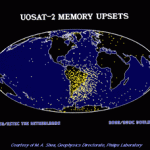
October 19-26, 1989 – A series of powerful solar flares caused many satellites to experience about five years of solar panel degradation in just seven days. Satellites that were designed to last 10 years, were now expected to last only five before their panels could no longer provide full power. The GEOS-7 weather satellite lost half of its mission lifetime in just this way, from a single solar flare in March 1989. A13-satellite geostationary satellite constellation reported 187 ‘glitches’ with its attitude system.
December 8, 1991 – Major aurora.
January 20, 1994 – A series of coronal holes had just swept across the Sun between January 13-19th. NASA’s, SAMPEX satellite, detects signs of energetic electrons near geosynchronous orbit, whose concentration were rising to a maximum. As the GOES satellites began to accumulate electric charges from the influx of energetic particles, the Intelsat-K satellite began to wobble on January 20, 1994, and experienced a short outage of service. About two hours later, the Anik satellites took their turn in dealing with these changing space conditions, and did not do as well. The satellites experienced almost identical failures having to do with their momentum wheel control systems. The first to go was Anik E1 at 12:40 PM which began to roll end-over-end uncontrollably. The Canadian Press was unable to deliver news to over 100 newspapers and 450 radio stations for the rest of the day, but was able to use the Internet as an emergency back-up. Telephone users in 40 northern Canadian communities were left without service. It took over seven hours for Telesat Canada’s engineers to correct Anik E1’s pointing problems using a back-up momentum wheel system. About 70 minutes later at 9:10 PM, the Anik E2 satellite’s momentum wheel system failed, but its backup system also failed, so the satellite continued to spin slowly, rendering it useless. This time, 3.6 million Canadians were affected as their major TV satellite went out of service. Popular programs such as MuchMusic, TSN and the Weather Channel were knocked off the air for three hours while engineers rerouted the services to Anik E1. For many months, Telesat Canada wrestled with the enormous problem of trying to re-establish control of Anik E2. They were not about to scrap a $300 million satellite without putting up a fight. After five months of hard work, they were at last able to regain control of Anik E2 4 on 21 June 1994. The bad news is that, instead of relying on the satellite’s now useless pointing system, they would send commands up to the satellite to fire its thrusters every minute or so to keep it properly pointed. This ground intervention would have to continue until they ran out of thruster fuel, shortening the satellites lifespan by several years. The good news is that Telesat Canada became the first satellite company to actively stabilize a satellite without using any satellite attitude system. In the end, it would turn out to be something of a Pyrrhic victory because on March 26, 1996 at 3:45 PM, a crucial diode on the Anik E1 solar panel shorted out, causing a permanent loss of half the satellite’s power. Investigators later concluded that this, too, was caused by an unlucky solar event. [Aviation Week and Space Technology, 1/31 p. 24 Toronto Sun 1/21 p.7]
January 9, 1997 – The massive cloud launched from the Sun, crossed the orbit of Mercury in less than a day. At a distance of one million miles from the Earth, the leading edge of the invisible cloud finally made contact with NASA’s WIND satellite at 8:00 PM EST on January 9. By 11:30 PM the particle and field monitors onboard NASA’s earth-orbiting POLAR and GEOTAIL satellites told their own stories about the blast of energetic particles now sweeping through the solar system. Interplanetary voyagers would never have suspected the conflagration that had just swept over them. The cloud had a density hardly more than the best laboratory vacuums. Nearly a trillion cubic miles of space were now involved in a pitched battle between particles and fields, shaking the Earth’s magnetic field for over 24 hours. The storminess in space rode the tendrils of the Earth’s field all the way down to the ground in a barrage of activity. Major aurora blazed forth in Siberia, Alaska and across much of Canada during this long winter’s night. The initial blast from the cloud (astronomers call it a ‘coronal mass ejection’ or CME), compressed the magnetosphere and drove it inside the orbits of geosynchronous satellites, amplifying trapped particles to high energies. Dozens of satellites positioned at fixed longitudes along the Earth’s equator like beads on a necklace, alternately entered and exited the full-bore of the solar wind every 24 hours as they passed outside of the Earth’s magnetic shield. Plasma analyzers developed by Los Alamos Laboratories, and piggybacked on several geosynchronous satellites, recorded voltages as high as 1000 volts, as static electric charges danced on their outer surfaces. It was turning out to be not a very pleasant environment for these high-tech islands of silicon and aluminum. Just as the conditions began to subside, on January 11th, the Earth was hit by a huge pressure pulse as the trailing edge of the cloud finally passed by. The arrival and departure of this cloud would have not been of more than scientific interest, had it not also incapacitated a $200 million communications satellite in its wake at 06:15 EST: Telstar 401. AT&T tried to restore satellite operations for several more days, but on January 17th they finally admitted defeat and decommissioned the satellite. All TV programs such as ‘Oprah Winfrey’, ‘Bay Watch’, ‘The Simpsons’, and feeds for ABC News, had to be switched to a spare satellite, Telstar 402R. This outage affected a $712 million sale of AT&Ts Skynet telecommunications resources to Loral Space and Communications Ltd. [Science News 1/20 p.1]
July 15, 2000. The Bastille Day Storm arrived during the daytime over a beclouded North America. Intensely followed by the news media, it produced only sporadic aurora sightings because by the time it arrived its greatest impact was on the daytime side of earth. The International Space Station loses about 15 kilometers of altitude in its orbit.
March 31, 2001 This Easter Storm was tracked from cradle to grave by NASA and ESA satellites. The CME emerged from tangled magnetic conditions overlying one of the largest sunspot groups seen in several decades. The sunspot group was the largest seen on the sun in a decade, and produced several powerful X-class flares. It was highly publicized in the news media.
October 29, 2003 – This Halloween Storm spawned auroras that were seen over most of North America. Extensive satellite problems were reported, including the loss of the $450 million Midori-2 research satellite. Highly publicized in the news media. A huge solar storm impacted the Earth, just over 19 hours after leaving the sun. This is probably the second fastest solar storm in historic times, only beaten by the perfect solar storm in the year 1859 which spent an estimated 17 hours in transit.
November 4, 2003 – One of the most powerful x-ray flares ever detected , it swamped the sensors of dozens of satellites, causing satellite operations anomalies, but no aurora. Originally classified as an X28 flare, it was upgrade by OAA scientists to X34 a month later. Astronauts hid deep within the body of the International Space Station, but still reported radiation effects and ocular shooting stars. Highly publicized in the news media but produced no aurora. It was also not seen as a white-light flare.
November 20, 2003 No CME was involved in this storm, which appeared after Earths passage through a high-speed coronal wind stream. Spectacular aurora were observed across North America, and newspaper accounts abounded.
Submit your review | |